In radiotelegraphy, the safety signal consist of three repetitions of the group TTT, the individual letters of each group and the successive group being clearly separated from each other. It shall be sent before the call.
In radiotelephony, the safety signal consist of the word “SECURITE” pronounced clearly as in French, spoken three times and transmitted before the call.
This safety signal indicates that the station is about to transmit a message containing an important navigation or important meteorological warning. Safety signal and call shall be sent on or more of the international distress frequencies (500, 2182 khz,156.8) Mhz or any other frequency which may be used in case of distress.
The safety message which follows the call should be sent on a working frequency. A suitable announcement to this effect shall be made at he end of the call. In the maritime mobile service, safety messages shall generally be addressed to all stations. In some cases, however, they may be addressed to a particular station. All stations hearing the safety signal shall listen to the safety message until they are satisfied that the message is of no concern to them. They shall not make any transmission likely to interfere with the message.
Wednesday, November 12, 2008

Friday, November 7, 2008
ACKNOWLEDGEMENT OF RECEIPT OF A DISTRESS MESSAGE
1. Stations of the mobile service which receive a distress message from a mobile station which is, beyond any possible doubt in their vicinity, shall immediately acknowledge receipt.
2. However, in areas where reliable communications with one or more coast stations are practicable. Ship station should defer this acknowledgement for a short interval so that a coast station may be acknowledge receipt.
3. Station of the mobile service which receive a distress message from a mobile station which, beyond any possible doubt, is not in their vicinity, shall allow a short interval of time to elapse before acknowledging receipt of the message, in order to permit stations nearer to the mobile station in distress to acknowledge receipt without interference.
4. However, stations in the marine service which receive a distress message from a mobile station which, beyond any possible doubt, is a long distance away need not acknowledge receipt of messages except as specified.
THE ACKNOWLEDGEMENT OF RECEIPT OF A DISTRESS MESSAGE SHALL BE GIVEN IN THE FOLLOWING FORM:
a) RADIOTELEGRAPHY:
*the distress signal SOS
*the call sign of the station sending the distress message, sent three times
*the word DE
*the distress signal SOS
b) RADIOTELEPHONY:
*the distress signal MAYDAY
*the call sigh sending the distress message, spoken 3 times
*the word THIS IS or DE spoken as DELTA ECHO in case of language difficulties
*the call sign or other identification of the station acknowledging the message, spoken three times.
*the word RECEIVED (or RRR spoken as ROMEO ROMEO ROMEO in case of language difficulties)
*the distress signal MAYDAY
2. However, in areas where reliable communications with one or more coast stations are practicable. Ship station should defer this acknowledgement for a short interval so that a coast station may be acknowledge receipt.
3. Station of the mobile service which receive a distress message from a mobile station which, beyond any possible doubt, is not in their vicinity, shall allow a short interval of time to elapse before acknowledging receipt of the message, in order to permit stations nearer to the mobile station in distress to acknowledge receipt without interference.
4. However, stations in the marine service which receive a distress message from a mobile station which, beyond any possible doubt, is a long distance away need not acknowledge receipt of messages except as specified.
THE ACKNOWLEDGEMENT OF RECEIPT OF A DISTRESS MESSAGE SHALL BE GIVEN IN THE FOLLOWING FORM:
a) RADIOTELEGRAPHY:
*the distress signal SOS
*the call sign of the station sending the distress message, sent three times
*the word DE
*the distress signal SOS
b) RADIOTELEPHONY:
*the distress signal MAYDAY
*the call sigh sending the distress message, spoken 3 times
*the word THIS IS or DE spoken as DELTA ECHO in case of language difficulties
*the call sign or other identification of the station acknowledging the message, spoken three times.
*the word RECEIVED (or RRR spoken as ROMEO ROMEO ROMEO in case of language difficulties)
*the distress signal MAYDAY
General Radiotelephone Emergency Communications
Emergency Conditions
Emergency conditions are classified in accordance with the degree of danger or hazard as follows:
Distress: A condition of being threatened by grave and/or imminent danger and requiring immediate assistance.
Urgency: A condition concerning the safety of an aircraft or other vehicle, or of someone on board or within sight, but which does not require immediate assistance.
Safety: An indication that the station calling is about to transmit a message concerning the safety of navigation or important meteorological warnings.
Distress, urgency and safety procedures are outlined in regulations and are designed primarily for the aeronautical and maritime services. Use of these types of communications in the land mobile service is very rare.
Since detailed procedures for distress, urgency and safety communications have not been expressly developed for use in the land-mobile service, a brief outline of procedures for providing safety-related communications is given in the following sections.
* Distress Communications
Distress communications should be conducted in accordance with the procedures outlined in this section. These procedures shall not, however, prevent a station in distress from making use of any means at its disposal to attract attention, to make known its position, and to obtain assistance.
* Frequencies to Be Used
The first transmission of the distress call and message by a station should be made on the frequency in use at the time. If the station is unable to establish communications on the frequency in use, the distress call and message should be repeated on any other frequency available in an effort to establish communications with any other station.
* Distress Signal
In radiotelephony, the spoken word for distress is "MAYDAY", and it should be used at the commencement of the first distress communication.
The distress signal indicates that a person or station sending the signal is:
1. threatened by grave and imminent danger and requires immediate assistance, or
2. aware that an aircraft, ship, other station or person is threatened by grave and imminent danger and requires immediate assistance.
Return to Top of Page
Top of Page
Priority of Distress
The distress call has absolute priority over all other transmissions. All stations which hear it shall immediately cease any transmission capable of interfering with distress traffic and continue to listen on the frequency used for the distress call.
* Control of Distress Traffic
The control of distress traffic is the responsibility of the station in distress or of the station which relays the distress message. These stations may, however, delegate the control of distress traffic to another station.
* Distress Call
The distress call identifies the station in distress, and such calls shall only be sent on the authority of the person in command of the station. The distress call should comprise:
1. the distress signal "MAYDAY" spoken three times;
2. the words "THIS IS";
3. the call sign of the station in distress spoken three times.
Example:
MAYDAY, MAYDAY, MAYDAY
THIS IS
PIPER CHARLIE FOXTROT X-RAY QUEBEC QUEBEC
PIPER CHARLIE FOXTROT X-RAY QUEBEC QUEBEC
PIPER CHARLIE FOXTROT X-RAY QUEBEC QUEBEC
The distress call shall not be addressed to a particular station and acknowledgement of receipt shall not be given before the distress message is sent.
* Distress Message
The distress message shall follow the distress call as soon as possible.
The distress message should include as many as possible of the following elements spoken distinctly and, if possible, in the following order:
1. the distress signal "MAYDAY";
2. the call of the sign station in distress (once);
3. the nature of the distress condition and the kind of assistance required (i.e. what has happened);
4. the intentions of the person in command;
5. the particulars of its position (location, airspeed, altitude, heading);
6. the number of persons on board and injuries (if applicable);
7. any other information that might facilitate the rescue;
8. the call sign of the station in distress.
Example: MAYDAY
PIPER CHARLIE FOXTROT X-RAY QUEBEC QUEBEC
STRUCK BY LIGHTNING
DITCHING AIRCRAFT
POSITION: 20 MILES EAST OF WINNIPEG
ALTITUDE: 1500 FEET
AIRSPEED: 125 KNOTS
HEADING: 270 T
ONE PERSON ON BOARD
PIPER CHARLIE FOXTROT X-RAY QUEBEC QUEBEC
Note: If the station operator can transmit the distress message immediately after the distress call, then items 1 and 2 may be omitted from the message.
* Repetition of a Distress Message
The distress message shall be repeated at intervals by the station in distress until an answer is received or until it is no longer feasible to continue. The intervals between repetitions of the distress message shall be sufficiently long enough to allow time for stations receiving the message to reply.
Any station that has heard an unacknowledged distress message and is not in a position to render assistance, shall take all possible steps to attract the attention of other stations that are in a position to assist.
In addition, all necessary steps shall be taken to notify the appropriate search and rescue authorities of the situation.
Return to Top of Page
Top of Page
* Action by Station in Distress
When a station is threatened by grave and imminent danger, and requires immediate assistance, the person in command should direct appropriate action as follows:
1. transmit the distress call;
2. transmit the distress message;
3. listen for acknowledgement of receipt;
4. exchange further distress traffic as applicable;
5. activate automatic emergency equipment (emergency locator transmitter - ELT) if available and when appropriate.
* Action by Stations Other than the Station in Distress
A station that is not in distress should transmit the distress message when:
1. the station in distress is not in a position to transmit the message, or
2. the person in command of the station that intervenes believes that further help is necessary.
When a distress message is received and it is known that the affected station is not in the immediate vicinity, sufficient time should be allowed before the distress message is acknowledged. This will permit stations nearer to the station in distress to reply.
* Action by Other Stations Hearing a Distress Message
1. Continue to monitor the frequency on which the distress message was received and, if possible, establish a continuous watch on appropriate distress and emergency frequencies.
2. Notify any station with direction-finding or radar facilities and request assistance unless it is known that this action has been, or will be, taken by the station acknowledging receipt of the distress message.
3. Cease all transmissions that may interfere with the distress traffic.
* Distress Traffic
Distress traffic consists of all transmissions relative to the immediate assistance required by the station in distress. Essentially, all transmissions made after the initial distress call are considered as distress traffic. In distress traffic, the distress signal "MAYDAY" spoken once, shall precede all transmissions. This procedure is intended to alert stations not aware of the initial distress call and now monitoring the distress channel that traffic heard relates to a distress situation.
Any station in the land mobile, aeronautical, or maritime mobile service that has knowledge of distress traffic and cannot itself assist the station in distress shall follow such traffic until it is evident that assistance is being provided. All stations that are aware of distress traffic, and that are not taking part in it, are forbidden to transmit on the frequencies being used for distress traffic until a message is received indicating that normal working traffic may be resumed (cancellation of distress).
5.2.12 Acknowledgement of Receipt of a Distress Message
The acknowledgement of receipt of a distress message shall be given in the following form:
1. the distress signal "MAYDAY"
2. the call sign of the station in distress (spoken three times);
3. the words "THIS IS";
4. 4. the call sign of the station acknowledging receipt (spoken three times);
5. the words "RECEIVED MAYDAY".
Example: MAYDAY
PIPER CHARLIE FOXTROT X-RAY QUEBEC QUEBEC
PIPER CHARLIE FOXTROT X-RAY QUEBEC QUEBEC
PIPER CHARLIE FOXTROT X-RAY QUEBEC QUEBEC
THIS IS WINNIPEG TOWER
WINNIPEG TOWER
WINNIPEG TOWER
RECEIVED MAYDAY
5.2.13 Action by Stations Acknowledging Receipt of a Distress Message
1. Forward information immediately to the appropriate search and rescue agencies or organizations.
2. Continue to monitor the frequency on which the distress message was received and, if possible, any other frequency that may be used by the station in distress.
3. Notify any station with direction-finding or radar facilities that may be of assistance, etc.
4. Cease all transmissions that may interfere with the distress traffic.
Return to Top of Page
Top of Page
Relay of a Distress Message
A distress message repeated by a station other than the station in distress shall transmit a signal comprised of:
1. the signal "MAYDAY RELAY" (spoken three times);
2. the words "THIS IS";
3. the call sign of the station relaying the message (spoken three times);
4. the distress signal "MAYDAY" (once);
5. the particulars of the station in distress such as its location, the nature of distress, the number of persons on board, etc.
Example: MAYDAY RELAY, MAYDAY RELAY, MAYDAY RELAY
THIS IS
CESSNA CHARLIE NOVEMBER JULIETT INDIA
CESSNA CHARLIE NOVEMBER JULIETT INDIA
CESSNA CHARLIE NOVEMBER JULIETT INDIA
MAYDAY
PIPER CHARLIE FOXTROT X-RAY QUEBEC QUEBEC
STRUCK BY LIGHTNING
DITCHING AIRCRAFT
POSITION: 20 MILES EAST OF WINNIPEG
ALTITUDE: 1500 FEET
AIRSPEED: 125 KNOTS
HEADING: 270 DEGREES
ONE PERSON ON BOARD
PIPER CHARLIE FOXTROT X-RAY QUEBEC QUEBEC
* Imposition of Silence
The station in distress, or the station in control of distress traffic, may impose silence on all stations in the area or on any station that interferes with the distress traffic. It shall address these instructions to "all stations", or to one station only as appropriate.
The station in distress, or the station in control, shall use the expression "SEELONCE MAYDAY".
If it is believed to be essential, other stations near the station in distress may also impose silence during a distress situation by using the international expression "SEELONCE DISTRESS".
Should radio silence be imposed during a distress situation, all transmissions shall cease immediately except for those stations involved in distress traffic.
Examples: Imposition of silence on a specific station by the station in distress.
(Cessna C-FNJI is causing interference to distress traffic.)
CESSNA CHARLIE FOXTROT NOVEMBER JULIETT INDIA
THIS IS
PIPER CHARLIE FOXTROT X-RAY QUEBEC QUEBEC
SEELONCE MAYDAY
OUT
Imposition of silence on all stations by a station other than the station in distress.
ALL STATIONS, ALL STATIONS, ALL STATIONS
THIS IS
CESSNA CHARLIE FOXTROT NOVEMBER JULIETT INDIA
SEELONCE DISTRESS
OUT
* Cancellation of Distress
When a station is no longer in distress, or when it is no longer necessary to observe radio silence (i.e. the rescue operation has concluded), the station that controlled the distress traffic shall transmit a message addressed to "ALL STATIONS" on the distress frequency(ies) used, advising that normal operation may resume. The proper procedure for cancelling a distress message is:
1. the distress signal "MAYDAY" (once);
2. the words "HELLO ALL STATIONS" (three times);
3. the words "THIS IS";
4. the name or call sign of the station transmitting the message;
5. the filing time of the message;
6. the call sign of the station in distress (once);
7. the words "SEELONCE FEENEE";
Example:
MAYDAY
HELLO ALL STATIONS, HELLO ALL STATIONS, HELLO ALL STATIONS
THIS IS
WINNIPEG TOWER
TIME 1630 ZULU
PIPER CHARLIE FOXTROT X-RAY QUEBEC QUEBEC
SEELONCE FEENEE
OUT
Note: The procedure outlined above is mainly for the benefit of other stations so they can resume regular service. To ensure that search and rescue stations are advised that a station is no longer in distress, a normal call to the nearest rescue coordination centre detailing the reasons for cancelling the distress call MUST be made.
Emergency conditions are classified in accordance with the degree of danger or hazard as follows:
Distress: A condition of being threatened by grave and/or imminent danger and requiring immediate assistance.
Urgency: A condition concerning the safety of an aircraft or other vehicle, or of someone on board or within sight, but which does not require immediate assistance.
Safety: An indication that the station calling is about to transmit a message concerning the safety of navigation or important meteorological warnings.
Distress, urgency and safety procedures are outlined in regulations and are designed primarily for the aeronautical and maritime services. Use of these types of communications in the land mobile service is very rare.
Since detailed procedures for distress, urgency and safety communications have not been expressly developed for use in the land-mobile service, a brief outline of procedures for providing safety-related communications is given in the following sections.
* Distress Communications
Distress communications should be conducted in accordance with the procedures outlined in this section. These procedures shall not, however, prevent a station in distress from making use of any means at its disposal to attract attention, to make known its position, and to obtain assistance.
* Frequencies to Be Used
The first transmission of the distress call and message by a station should be made on the frequency in use at the time. If the station is unable to establish communications on the frequency in use, the distress call and message should be repeated on any other frequency available in an effort to establish communications with any other station.
* Distress Signal
In radiotelephony, the spoken word for distress is "MAYDAY", and it should be used at the commencement of the first distress communication.
The distress signal indicates that a person or station sending the signal is:
1. threatened by grave and imminent danger and requires immediate assistance, or
2. aware that an aircraft, ship, other station or person is threatened by grave and imminent danger and requires immediate assistance.
Return to Top of Page
Top of Page
Priority of Distress
The distress call has absolute priority over all other transmissions. All stations which hear it shall immediately cease any transmission capable of interfering with distress traffic and continue to listen on the frequency used for the distress call.
* Control of Distress Traffic
The control of distress traffic is the responsibility of the station in distress or of the station which relays the distress message. These stations may, however, delegate the control of distress traffic to another station.
* Distress Call
The distress call identifies the station in distress, and such calls shall only be sent on the authority of the person in command of the station. The distress call should comprise:
1. the distress signal "MAYDAY" spoken three times;
2. the words "THIS IS";
3. the call sign of the station in distress spoken three times.
Example:
MAYDAY, MAYDAY, MAYDAY
THIS IS
PIPER CHARLIE FOXTROT X-RAY QUEBEC QUEBEC
PIPER CHARLIE FOXTROT X-RAY QUEBEC QUEBEC
PIPER CHARLIE FOXTROT X-RAY QUEBEC QUEBEC
The distress call shall not be addressed to a particular station and acknowledgement of receipt shall not be given before the distress message is sent.
* Distress Message
The distress message shall follow the distress call as soon as possible.
The distress message should include as many as possible of the following elements spoken distinctly and, if possible, in the following order:
1. the distress signal "MAYDAY";
2. the call of the sign station in distress (once);
3. the nature of the distress condition and the kind of assistance required (i.e. what has happened);
4. the intentions of the person in command;
5. the particulars of its position (location, airspeed, altitude, heading);
6. the number of persons on board and injuries (if applicable);
7. any other information that might facilitate the rescue;
8. the call sign of the station in distress.
Example: MAYDAY
PIPER CHARLIE FOXTROT X-RAY QUEBEC QUEBEC
STRUCK BY LIGHTNING
DITCHING AIRCRAFT
POSITION: 20 MILES EAST OF WINNIPEG
ALTITUDE: 1500 FEET
AIRSPEED: 125 KNOTS
HEADING: 270 T
ONE PERSON ON BOARD
PIPER CHARLIE FOXTROT X-RAY QUEBEC QUEBEC
Note: If the station operator can transmit the distress message immediately after the distress call, then items 1 and 2 may be omitted from the message.
* Repetition of a Distress Message
The distress message shall be repeated at intervals by the station in distress until an answer is received or until it is no longer feasible to continue. The intervals between repetitions of the distress message shall be sufficiently long enough to allow time for stations receiving the message to reply.
Any station that has heard an unacknowledged distress message and is not in a position to render assistance, shall take all possible steps to attract the attention of other stations that are in a position to assist.
In addition, all necessary steps shall be taken to notify the appropriate search and rescue authorities of the situation.
Return to Top of Page
Top of Page
* Action by Station in Distress
When a station is threatened by grave and imminent danger, and requires immediate assistance, the person in command should direct appropriate action as follows:
1. transmit the distress call;
2. transmit the distress message;
3. listen for acknowledgement of receipt;
4. exchange further distress traffic as applicable;
5. activate automatic emergency equipment (emergency locator transmitter - ELT) if available and when appropriate.
* Action by Stations Other than the Station in Distress
A station that is not in distress should transmit the distress message when:
1. the station in distress is not in a position to transmit the message, or
2. the person in command of the station that intervenes believes that further help is necessary.
When a distress message is received and it is known that the affected station is not in the immediate vicinity, sufficient time should be allowed before the distress message is acknowledged. This will permit stations nearer to the station in distress to reply.
* Action by Other Stations Hearing a Distress Message
1. Continue to monitor the frequency on which the distress message was received and, if possible, establish a continuous watch on appropriate distress and emergency frequencies.
2. Notify any station with direction-finding or radar facilities and request assistance unless it is known that this action has been, or will be, taken by the station acknowledging receipt of the distress message.
3. Cease all transmissions that may interfere with the distress traffic.
* Distress Traffic
Distress traffic consists of all transmissions relative to the immediate assistance required by the station in distress. Essentially, all transmissions made after the initial distress call are considered as distress traffic. In distress traffic, the distress signal "MAYDAY" spoken once, shall precede all transmissions. This procedure is intended to alert stations not aware of the initial distress call and now monitoring the distress channel that traffic heard relates to a distress situation.
Any station in the land mobile, aeronautical, or maritime mobile service that has knowledge of distress traffic and cannot itself assist the station in distress shall follow such traffic until it is evident that assistance is being provided. All stations that are aware of distress traffic, and that are not taking part in it, are forbidden to transmit on the frequencies being used for distress traffic until a message is received indicating that normal working traffic may be resumed (cancellation of distress).
5.2.12 Acknowledgement of Receipt of a Distress Message
The acknowledgement of receipt of a distress message shall be given in the following form:
1. the distress signal "MAYDAY"
2. the call sign of the station in distress (spoken three times);
3. the words "THIS IS";
4. 4. the call sign of the station acknowledging receipt (spoken three times);
5. the words "RECEIVED MAYDAY".
Example: MAYDAY
PIPER CHARLIE FOXTROT X-RAY QUEBEC QUEBEC
PIPER CHARLIE FOXTROT X-RAY QUEBEC QUEBEC
PIPER CHARLIE FOXTROT X-RAY QUEBEC QUEBEC
THIS IS WINNIPEG TOWER
WINNIPEG TOWER
WINNIPEG TOWER
RECEIVED MAYDAY
5.2.13 Action by Stations Acknowledging Receipt of a Distress Message
1. Forward information immediately to the appropriate search and rescue agencies or organizations.
2. Continue to monitor the frequency on which the distress message was received and, if possible, any other frequency that may be used by the station in distress.
3. Notify any station with direction-finding or radar facilities that may be of assistance, etc.
4. Cease all transmissions that may interfere with the distress traffic.
Return to Top of Page
Top of Page
Relay of a Distress Message
A distress message repeated by a station other than the station in distress shall transmit a signal comprised of:
1. the signal "MAYDAY RELAY" (spoken three times);
2. the words "THIS IS";
3. the call sign of the station relaying the message (spoken three times);
4. the distress signal "MAYDAY" (once);
5. the particulars of the station in distress such as its location, the nature of distress, the number of persons on board, etc.
Example: MAYDAY RELAY, MAYDAY RELAY, MAYDAY RELAY
THIS IS
CESSNA CHARLIE NOVEMBER JULIETT INDIA
CESSNA CHARLIE NOVEMBER JULIETT INDIA
CESSNA CHARLIE NOVEMBER JULIETT INDIA
MAYDAY
PIPER CHARLIE FOXTROT X-RAY QUEBEC QUEBEC
STRUCK BY LIGHTNING
DITCHING AIRCRAFT
POSITION: 20 MILES EAST OF WINNIPEG
ALTITUDE: 1500 FEET
AIRSPEED: 125 KNOTS
HEADING: 270 DEGREES
ONE PERSON ON BOARD
PIPER CHARLIE FOXTROT X-RAY QUEBEC QUEBEC
* Imposition of Silence
The station in distress, or the station in control of distress traffic, may impose silence on all stations in the area or on any station that interferes with the distress traffic. It shall address these instructions to "all stations", or to one station only as appropriate.
The station in distress, or the station in control, shall use the expression "SEELONCE MAYDAY".
If it is believed to be essential, other stations near the station in distress may also impose silence during a distress situation by using the international expression "SEELONCE DISTRESS".
Should radio silence be imposed during a distress situation, all transmissions shall cease immediately except for those stations involved in distress traffic.
Examples: Imposition of silence on a specific station by the station in distress.
(Cessna C-FNJI is causing interference to distress traffic.)
CESSNA CHARLIE FOXTROT NOVEMBER JULIETT INDIA
THIS IS
PIPER CHARLIE FOXTROT X-RAY QUEBEC QUEBEC
SEELONCE MAYDAY
OUT
Imposition of silence on all stations by a station other than the station in distress.
ALL STATIONS, ALL STATIONS, ALL STATIONS
THIS IS
CESSNA CHARLIE FOXTROT NOVEMBER JULIETT INDIA
SEELONCE DISTRESS
OUT
* Cancellation of Distress
When a station is no longer in distress, or when it is no longer necessary to observe radio silence (i.e. the rescue operation has concluded), the station that controlled the distress traffic shall transmit a message addressed to "ALL STATIONS" on the distress frequency(ies) used, advising that normal operation may resume. The proper procedure for cancelling a distress message is:
1. the distress signal "MAYDAY" (once);
2. the words "HELLO ALL STATIONS" (three times);
3. the words "THIS IS";
4. the name or call sign of the station transmitting the message;
5. the filing time of the message;
6. the call sign of the station in distress (once);
7. the words "SEELONCE FEENEE";
Example:
MAYDAY
HELLO ALL STATIONS, HELLO ALL STATIONS, HELLO ALL STATIONS
THIS IS
WINNIPEG TOWER
TIME 1630 ZULU
PIPER CHARLIE FOXTROT X-RAY QUEBEC QUEBEC
SEELONCE FEENEE
OUT
Note: The procedure outlined above is mainly for the benefit of other stations so they can resume regular service. To ensure that search and rescue stations are advised that a station is no longer in distress, a normal call to the nearest rescue coordination centre detailing the reasons for cancelling the distress call MUST be made.
MARINE RADIOTELEPHONE
The Marine Radiotelephone Service or HF ship-to-shore operates on shortwave radio frequencies, using single-sideband modulation. The usual method is that a ship calls a shore station, and the shore station's marine operator connects the caller to the public switched telephone network. This service is retained for safety reasons, but in practice has been made obsolete by satellite telephones, particularly INMARSAT.
Short wave radio is used because it bounces between the ionosphere and the ground, giving a modest 1,000 watt transmitter (the standard power) a world-wide range.
Most shore stations monitor several frequencies. The frequencies with the longest range are usually near 20 MHz, but the ionospheric weather (propagation) can dramatically change which frequencies work best.
Single-sideband (SSB) is used because the short wave bands are crowded with many users, and SSB permits a single voice channel to use a narrower range of radio frequencies (bandwidth), about 3.5 kHz. In comparison, AM radio uses about 8 kHz, and narrowband (voice or communication-quality) FM uses 9 kHz.
Marine radiotelephony first became common in the 1930s, and was used extensively for communications to ships and aircraft over water. In that time, most long-range aircraft had long-wire antennas that would be let out during a call, and reeled-in afterward.
One of the most important uses of marine radiotelephony has been to change ships' itineraries, and to perform other business at sea.
Some ships, including almost all military ships, carry teletypewriters, and use them to communicate over short wave. This is called "marine radiotelegraphy", but in practice the equipment is a normal shortwave radio with an attachment that generates and receives audio tones in order to drive the teletype.
Short wave radio is used because it bounces between the ionosphere and the ground, giving a modest 1,000 watt transmitter (the standard power) a world-wide range.
Most shore stations monitor several frequencies. The frequencies with the longest range are usually near 20 MHz, but the ionospheric weather (propagation) can dramatically change which frequencies work best.
Single-sideband (SSB) is used because the short wave bands are crowded with many users, and SSB permits a single voice channel to use a narrower range of radio frequencies (bandwidth), about 3.5 kHz. In comparison, AM radio uses about 8 kHz, and narrowband (voice or communication-quality) FM uses 9 kHz.
Marine radiotelephony first became common in the 1930s, and was used extensively for communications to ships and aircraft over water. In that time, most long-range aircraft had long-wire antennas that would be let out during a call, and reeled-in afterward.
One of the most important uses of marine radiotelephony has been to change ships' itineraries, and to perform other business at sea.
Some ships, including almost all military ships, carry teletypewriters, and use them to communicate over short wave. This is called "marine radiotelegraphy", but in practice the equipment is a normal shortwave radio with an attachment that generates and receives audio tones in order to drive the teletype.
Thursday, November 6, 2008
MAYDAY (DISTRESS CALL)

A Mayday situation is one in which a vessel, aircraft, vehicle, or person is in grave and imminent danger and requires immediate assistance. Examples of "grave and imminent danger" in which a mayday call would be appropriate include fire, explosion or sinking.
Mayday calls can be made on any frequency, and when a mayday call is made no other radio traffic is permitted except to assist in the emergency. A mayday call may only be made when life or craft is in imminent danger of death or destruction.
'Mayday' calls are made by radio, such as a ship or aircraft's VHF radio. Although a Mayday call will be understood regardless of the radio frequency on which it is broadcast, first-line response organisations, such as the coastguard and air traffic control, monitor designated channels: marine MF on 2182 kHz; marine VHF radio channel 16 (156.8 MHz); and airband frequencies of 121.5 MHz and 243.0 MHz. A Mayday call is roughly equivalent of a morse code SOS, or a telephone call to the emergency services.
When they receive a Mayday call the coastguard may launch lifeboats and helicopters to assist the ship that is in trouble. Other ships that are nearby may divert course to assist the vessel broadcasting the Mayday.
Making a hoax Mayday call is a criminal act in many countries because of the danger to the rescuers' lives that a search-and-rescue operation can create, as well as the very high costs of such rescue efforts. For example, making a false distress call in the U.S. is a federal crime carrying sanctions of up to six years imprisonment, and a fine of $250,000[2].
The coastguard can be contacted in situations that are not emergencies (out of fuel, etc.) by calling 'Coastguard, Coastguard, Coastguard, this is (name of vessel)', on VHF channel 16. In many countries special training and a licence are required to use a mobile radio transmitter legally, although anyone may legally use one to summon help in a real emergency.
The recommended distress call format includes the word MAYDAY spoken three times (repeated twice), followed by the vessel's name or callsign, also spoken three times, then MAYDAY and the name or callsign again. Vital information, including the position, nature of the emergency, assistance required and the number of people on board, should follow. A typical message might be:
"MAYDAY, MAYDAY, MAYDAY, this is NONSUCH, NONSUCH, NONSUCH. MAYDAY, NONSUCH. Position 54 25 North 016 33 West. My boat is on fire and sinking. I require immediate assistance. 4 people on board, are taking a lifeboat. OVER."
If a Mayday call cannot be sent because a radio is not available a variety of other distress signals and calls for help can be used. A Mayday can be sent on behalf of one vessel by another, using a convention called a Mayday Relay.
MAYDAY RELAY CALL
A Mayday relay call is made by one vessel on behalf of a different vessel which is in distress. If a vessel makes a Mayday call and it is not acknowledged by the coastguard after a single repetition and a two-minute wait a vessel receiving the Mayday call should attempt to contact the coastguard on behalf of the Mayday vessel by broadcasting a Mayday Relay on their behalf.
A Mayday Relay call should use the callsign of the transmitting vessel but give the name and position of the Mayday vessel.
Mayday Relay calls can be used to summon help for a vessel which is either too far offshore to contact the coastguard directly or without radio capabilities (though most vessels above a certain size or crew complement are legally required to carry two-way radio equipment, such equipment can potentially be damaged or destroyed).
MOUNTAIN DISTRESS SIGNAL

The recognised mountain distress signals are based on groups of three (six in the UK). A distress signal can be 3 fires or piles of rocks in a triangle, three blasts on a whistle, or three flashes of a light, in succession followed by a one minute pause and repeated until a response is received. Three blasts or flashes is the appropriate response.
In the Alps, the recommended way to signal distress is the Alpine distress signal: give six signals within a minute, then pause for a minute, repeating this until rescue arrives. A signal may be anything visual (waving clothes or lights, use of a signal mirror) or audible (shouts, whistles, etc.). The rescuers acknowledge with three signals per minute. To communicate with a helicopter in sight, raise both arms (forming the letter Y) to indicate "Yes" or "I need help" and stretch one arm up and one down (imitating the letter N) for "No" or "I do not need help". If semaphore flags are available, they can possibly be used to communicate with rescuers.
DISTRESS SIGNAL

AUTOMATIC DISTRESS SIGNAL UNIT
The radiotelegraphic distress signal consist of the group SOS, transmitted as a single signal in which the dashes are emphasized clearly from dots.
The radiotelephone distress signal consist of the word "MAYDAY" pronounced as the French expression "M'aider".
These distress signal indicate that a ship, aircraft or other vehicle is threatened by grave and imminent danger and request immediate assistance.
DISTRESS COMMUNICATIONS

The distress call shall have absolute priority over all transmission. All stations which hear it small immediately cease any transmission capable of interfering with the distress traffic and shall continue to listen on the frequency used for the emission of the distress call.
This shall not be addressed to a particular station and acknowledgement of receipt shall not be given before the distress message which follows it is sent.
The distress call and message shall be sent only on the authority of the master of the vessel or person responsible for the ship, aircraft or other vehicle carrying the mobile station or ship station.
OPERATIONAL BREVITY WORDS AND TERMINOLOGY
The following are two lists of operational brevity words and terms to provide common understanding and minimize radio transmissions while executing tactics described in this manual. This common understanding, however, is dependent on the following rules of engagement:
- These lists are not all inclusive.
- Use plain English when required.
- Words listed below should be used in lieu of words or phrases with similar definitions.
- When a flight lead makes directive calls, the wingman must respond with the directed action to the best of his ability.
- If the wingman uses a "directive" term/word, it is a request and the flight lead reserves the right to approve/deny the wingman's requested action.
Allied nations may have different meanings for some of the terms/words listed here (reference ACP 165). They are indicated by an asterisk (*) behind the term/word.
SECTION A: OPERATIONAL BREVITY WORDS
ABORT - Directive to cease action/attack/event/mission.
ACTION - Directive to initiate a briefed attack sequence or maneuver.
ALPHA CHECK - Request for bearing and range to described point.
ANCHOR - Orbit about a specific point; ground track flown by tanker. Information call indicates a turning engagement about a specific location.
ANGELS - Height of aircraft in thousands of feet.
APEX/ALAMO - Training term used to denote simulated launch of enemy, all-aspect radar missile.
APHID/ARCHER Training term used to denote simulated launch of enemy heat seeking missiles.
ARM/ARMED (Safe/Hot) - Select armament (safe/hot), or armament is safe/hot.
AS FRAGGED - Fighter, FAC, mission package, or agency will be performing exactly as stated by the air tasking order.
ASPECT - Request/comment regarding target aspect information.
ATTACK/ATTACKING() - Indicates air-to-surface attack on a specific ground target.
AUTHENTICATE() - To request or provide a response for a coded challenge.
AUTONOMOUS - Aircrew is operating without benefit of GCI/AWACS control.
BANDIT(Radar/Heat/Striker) - Known enemy aircraft and type ordnance capability, if known.
BASE (Number) - Reference number used to indicate such information as headings, altitudes, fuels, etc.
BEAM/BEAMER (Direction) - Aircraft maneuvering stabilized within 700 to 1100 aspect; generally given with cardinal directions: east, west, north, south.
BELLYCHECK - A momentary unloaded bank to check the blind side of a turning aircraft.
()BENT - Identified system inoperative.
BINGO - Prebriefed fuel state which is needed for recovery using prebriefed parameters.
BLIND - No visual contact with friendly aircraft; opposite of term "VISUAL."
BLOWTHROUGH - Directive/informational call that indicates aircraft will continue straight ahead at the merge and not turn with target/targets.
BOGEY - A radar/visual contact whose identity is unknown.
BOGEY DOPE/DOPE - Request for target information as briefed/available.
BONE - Term used to indicate the formation will remain in a Racetrack-type holding pattern (with all wingmen's tums into lead); exit formation must be specified by lead.
BOX - Groups/contacts/formations in a square or offset square.
BRACKET - Indicates geometry where aircraft will maneuver to a position on opposing sides either laterally or vertically from the target.
BREAK (Up/Down/Right/Left) - Directive to perform an immediate maximum performance turn in the indicated direction. Assumes a defensive situation.
BREVITY - Term used to denote radio frequency is becoming saturated/degraded and briefer transmissions must follow.
BROADCAST - Request/directive to switch to Broadcast Control.
BROKE LOCK - Loss of radar/IR lock-on (advisory).
BUDDY SPIKE (Position/Azimuth/Altitude) - Receiving friendly AI RWR.
BUGOUT (Direction)Separation from that particular engagement/attack; no intent to reengage.
BULLSEYE - An established reference point from which the position of an aircraft can be determined.
BUMP/BUMP-UP - A fly-up to acquire line of sight to the target or laser designation.
BUNT - A pushover maneuver.
BURNER - Directive to select/deselect afterburner.
BUZZER - Electronic communications jamming.
CAP/CAP(Location) - An orbit at a specified location. Establish a combat air patrol at (location).
CHAFF - Call indicating chaff has been detected or to deploy chaff.
CHAMPAGNE - An attack of three distinct groups with two in front and one behind. The leading two groups are attempting to bracket with the trailing third group flying up the middle.
CHATTERMARK - Begin using briefed radio procedures to counter comm jamming.
CHECK ( ) - A directive statement made to momentarily monitor (specified items/systems).No response is required if status is normal.
CHECK ( Left/ Right) - Turn ( ) degrees left/right and maintain new heading.
CHICKS - Friendly fighter aircraft.
CHRISTMAS TREE - Directive to briefly turn on exterior lights to enable visual acquisition.
CIRCLE (RIGHT/LEFT) - Flight-lead-directed defensive maneuver in which the flight establishes a circular holding pattern for mutual support.
CLEAN - No radar contacts; used to confirm a good battle damage check (i.e., no air-to-surface ordnance remaining on the wingman's aircraft).
CLEARED - Requested action is authorized (no engaged/support roles are assumed).
CLEARED DRY - Ordnance release not authorized.
CLEARED HOT - Ordnance release is authorized.
CLOSING - Bandit/bogey/target is getting closer in range.
COLD - In context; attack geometry will result in a pass or roll out behind the target; or, on a leg of the CAP pointed away from the anticipated threats. Air-to-surface, dry or no-ordnance attack.
COMEBACK (Left/Right) - Directive to reverse course.
COMEOFF (Left/Right/High/Low/Dry) - A directive to maneuver as indicated to either regain mutual support or to deconflict flight paths for an exchange of engaged and supporting roles. Implies both "visual" and "tally."
COMMITTED/COMMIT - Fighter intent to engage/intercept; weapons director (WD) continues to provide information.
CONTACT - Radar/IR contact at the stated position; should be in bearing, range, altitude (BRA), Bullseye, or geographic position format.
CONTINUE - Continue present maneuver; does not imply clearance to engage or expend ordnance.
COVER - Directive to assume briefed support position and responsibilities.
CRANK (Direction) - F-Pole maneuver; implies illuminating target at radar gimbal limits.
CROSS TURN/CROSS - A 1800 heading reversal by a flight where aircraft turn into each other.
CUTOFF - Request for, or directive to, intercept using cutoff geometry.
DEADEYE Informative call by an airborne laser designator indicating the laser is inoperative.
DEFENSIVE (Spike/Missle/SAM/Mud/AAA) - Aircraft is in a defensive position and maneuvering with reference to the stated condition. If no condition stated maneuvering is with respect to A/A threat.
DEPLOY - Directive for the flight to maneuver to briefed positioning.
DIVERT - Proceed to alternate mission/base.
DOLLY - Data link equipment
DRAG/DRAGGING (Direction) - Bogey/Bandit maneuvering to 60 degor less aspect.
ECHELON (Cardinaldirection) - Groups/contacts/formation with wingman displaced approximately 45 deg behind leader's wing line.
ELEMENT - Formation of two aircraft.
ENGAGED - Maneuvering with the intent of achieving a kill. If no additional information is provided (bearing, range, etc.), ENGAGED implies visual/radar acquisition of target
ESTIMATE - Using information available to provide data required, implies degradation.
EXTEND (Direction) Directive to gain energy and distance with the possible intent of reengaging.
EYEBALL - Fighter with primary visual identification responsibility.
FADED - Previous radar contact is lost
FAST - Target speed is estimated to be 600 knots ground mach 1 or greater.
FEET WET/DRY - Flying over water/land.
FENCE - Boundary separating hostile and friendly area.
FENCE CHECK - Set cockpit switches as appropriate.
FLANK/FLANKING - Target with a stable aspect of 120 deg. to 150 deg.
FLARES - Flares have been detected or directive to deploy flares.
FLASH (MODE) - Temporary activation of IFF transponder on desired mode/code.
FLOAT - Directive/informative to expand the formation laterally within visual limits to maintain a radar contact or prepare for a defensive response.
FOLLOW DOLLY - Follow data-link commands.
FOX - Air-to-air weapons employment.
FOX ONE - Simulated/actual launch of radar-guided missile.
FOX TWO - Simulated/actual launch of infrared-guided missile.
FOX THREE - Simulated/actual launch of AMRAAM/Phoenix missile.
FOX FOUR - Bomber gunner has simulated firing on a target.
FOX MIKE - VHF/FM radio.
FURBALL - A turning fight involving multiple aircraft.
GADGET - Fire control radar.
GIMBAL (Direction) - Radar target is approaching azimuth or elevation limits.
GO ACTIVE - Go to briefed Have Quick net.
GO SECURE - Activate secure voice communications.
GORILLA - Large force of indeterminable numbers and formation.
GREEN (Direction) - Direction determined to be clearest of enemy air-to-air activity.
GROUP - Radar target(s) within approximately 3 NM of each other.
GUN (Direction) - Visual acquisition of gunfire, AAA site, or AAA fire.
GUNS - An air-to-air or air-to-surface gunshot.
HARD (Direction) - High-G, energy sustaining turn.
HEAD - Target with an aspect of 160 deg. to 180 deg.
HEADS DOWN - Call to infom aircrew that leader/wingman is head-down in the cockpit and wingman/leader is responsible for clearing.
HEADS UP (Direction/Altitude) - Enemy/bogey got through; no kill.
HIGH - Target above 30,000 feet MSL.c
HIT - Radar return in search (A/A). Weapons impact within lethal distance (air-to-ground [A/G]).
HOLD DOWN - Directive to key transmitter for DF steer.
HOLDING HANDS - Aircraft in visual formation.
HOME PLATE - Home airfield.
HOOK (Left/Right) - Directive to perform an in-place 180 deg. turn.
HOT - In context; attack geometry will result in rollout in front of the target; or on a leg of the CAP pointing toward the anticipated threats (A/A). Ordnance employment authorized, expected, or completed (A/G).
HOTEL FOX - HF radio.
HOUND DOG - Informative call from support fighter to engaged fighter within visual arena that a shot opportunity exists. Implies tally/visual.
ID - Directive to intercept and identify the target; also aircrew ID accomplished, followed by type aircraft.
IN PLACE (Left, Right) - Perform indicated maneuver simultaneously.
JINK - Unpredictable maneuvers to negate a gun tracking solution.
JOKER - Fuel state above Bingo at which separation/bugout/event termination should begin.
JUDY - Aircrew has radar/visual contact on the correct target, has taken control of the intercept and only requires situation awareness information; weapons director (WD) will minimize radio transmissions.
KILL - Directive to commit on target with clearance to fire; in training, a fighter call to indicate kill criteria have been fulfilled.
LADDER - Three or more groups/contacts/formations in trail.
LINE ABREAST - Two groups/contacts/formations/aircraft side-by-side.
LOCKED (BRA/Direction) - Final radar lock-on; sort is not assumed
LOW - Target altitude below 10,000 feet AGL
MAGNUM - launch of AGM-88 HARM.
MARKING - leaving contrails or otherwise marking aircraft position.
MEDIUM - Target altitude between 10,000 feet AGL and 30,000 feet MSL.
MERGE(D) - Informative that friendlies and targets have arrived in the same visual arena.Call indicating radar returns have come together.
MICKEY - Have Quick time-of-day (TOD) signal.
MIDNIGHT - Informative call advising that command and control functions (GCI/AWACS) are no longer available.
MEL - Directive to select military power.
MUD (Direction-Type) - Indicates unknown RWR ground threat displayed; followed normally by clock position.
MUSIC - Electronic radar jamming. On AI radar, electronic deceptive jamming.
NAKED - No RWR indications. Opposite of term "spike".
NO JOY - Aircrew does not have visual contact with the target/bandit; opposite of term "TALLY."
NOTCH (Direction) - All-aspect missile defensive maneuver to place threat radar/missile near the beam.
OFF (Direction) - Informative call indicating attack is terminated and maneuvering to the indicated direction.
OFFSET (Direction) - Informative call indicating maneuver in a specified direction with reference to the target.
PACKAGE - Geographically isolated collection of groups/contacts/formations.
PADLOCKED - Informative call indicating aircrew cannot take eyes off an aircraft/ground target without risk of losing tally/visual.
PAINT - Friendly AAI/APX interrogation retum.
PARROT - IFF transponder.
PICTURE - Situation briefing which includes real-time information pertinent to a specific mission.
PIGEONS (Location) - Magnetic bearing and range to a specified point.
PITCH/PITCHBACK (Left/Right) - Directive call for fighter/flight to execute a nose-high heading reversal.
PLAYTIME - Amount of time aircraft can remain on station.
POINT - Directive for an element to turn towards each other either as a defensive response or to reestablish a mutually supportive formation.
POP - Starting climb for air-to-surface attack.
POPEYE - Flying in clouds or area of reduced visibility.
POSIT - Request for position; response normally in terms of a geographic landmark, or off a common reference point.
POST ATTACK (Direction) - WD transmission to indicate desired direction after completion of intercept/engagement.
POST HOLE - Rapid descending spiral.
POWER - Reminder to set the throttles appropriately considering the IR threat and desired energy state.
PRESS - Directive to continue the attack; mutual support will be maintained. Supportive role will be assumed.
PUMP - A briefed maneuver to stop closure on the threat or geographical boundry while maintaining situation awareness.
PURE - Call indicating pure pursuit is being used or directive call to go pure pursuit.
PUSH (Channel) - Go to designated frequency.
RAYGUN (Position/Azimuth/Altitude) - Radar lock-on to unknown aircraft. Request Buddy Spike/Naked reply.
RANCH HOUSE (Altitude) - Directive or informative indicating subject fighters will return to CAP.
REFERENCE (Direction) - Directive to assume stated heading.
RIFLE - AGM-65 launch.
ROGER - Indicates aircrew understands the radio transmission; does not indicate compliance or reaction.
RUMBA - Ownship maneuvering and ranging (OMAR), F-15 angle on ranging (AOR), F-16.
RUN/RUNNING (Direction) - Directive/Informative - Perform a defensive maneuver to place the threat radar/missile on the tail.
SAM (Direction) - Visual acquisition of a SAM or SAM launch. Should include position.
SANDWICHED - A situation where an aircraft/element finds themselves between opposing aircraft/elements.
SAUNTER - Fly at best endurance.
SEPARATE - Leaving a specific engagement; may or may not reenter.
SHACKLE - One weave; a single crossing of flight paths; maneuver to adjust/ regain formation parameters.
SHADOW - Follow indicated target.
SHIFT - Directive to illuminate second target with laser designator.
SHOOTER - Aircraft designated to employ ordnance.
SHOTGUN - Launch of antiradiation (SHRIKE) missile by Wild Weasel.
SICK - Described equipment is degraded.
SILENT - "GO SILENT" directive to initiate briefed EMCON procedures.
SKIP IT - Veto of fighter commit call; usually followed with further directions.
SLICE/SLICEBACK (Left/Right) - Directive to perform a high-G descending turn in the stated direction; usually 180 deg. turn.
SLOW - Target with ground speed of less than 300 kts.
SNAP SHOT - High-angle/high-LOS gun shot.
SNAP ( ) - An immediate vector (bearing and range) to the group described.
SORTED - Criteria have been met which ensure individual flight members have separate contacts; criteria can be met visually, electronically (radar) or both.
SPARKLE - Target marking by a gunship or FAC using incendiary rounds.
SPIKE - RWR indication of AT threat is displayed. Add clock position, and type threat (radar/heat) if able.
SPITTER (Direction) - An aircraft that has departed from the engagement.
SPLASH* - Target destroyed (air-to-air); weapons impact (air-to-ground).
SPLIT - Request to engage a threat; visual may not be maintained, requires flight lead acknowledgement (air-to-air). Also, directive to begin briefed maneuver/attack.
SPOOFING - Informative that voice deception is being employed.
SPOT - Informative that laser target designation is being received.
SQUAWK ( ) - Operate IFF as indicated or IFF is operating as indicated.
STACK - Two or more groups/contacts/formations with a high/low altitude separation in relation to each other.
STATUS - Request for an individual's tactical situation; response is normally "offensive," "defensive," or "neutral." May be suffixed by position and heading.
STERN - Request for, or directive to, intercept using stern geometry.
STINGER - Formation of two or more aircraft with a single in trail.
STRANGER - Unidentified traffic that is not a participant in the mission.
STRANGLE ( ) - Turn off equipment indicated.
STROBE - AI radar indications of noise radar jamming.
SUNRISE - Informative call that command and control functions are available from GCI/AWACS (opposite of MIDNIGHT).
SUPPORTING - The act of assisting the engaged fighter in killing the bandit while maintaining overall battle situation awareness.
SWITCH/SWITCHED - Indicates an attacker is changing from one aircraft to another.
TALLY - Sighting of a target/bandit; opposite of "NO JOY".
TARGET() - Specification of sort responsibility.
THREAT (Direction) - (GCI/AWACS) Informative that an untargeted bandit/bogey is within 10 NM of a friendly.
TIED - Positive radar contact with element/aircraft.
TRACK - A series of related contacts indicating direction of travel.
TRACKING - Stabilized gun solution.
TRAIL - Tactical formation of two or more aircraft following one another.
TRAILER - The last aircraft in a formation.
TRASHED - Informative call; missile in flight has been defeated.
TUMBLEWEED - Indicates limited situation awareness; no tally, no visual; a request for information.
UNIFORM - UHF/AM radio.
VIC - Three groups/contacts/formations with the single closest in range and an element in trail.
VICTOR - VHF/AM radio.
VISUAL - Sighting of a friendly aircraft; opposite of "BLIND."
WALL - Three or more groups/contacts/formations line abreast/side-side.
WEAVE - Continuous crossing of flight paths.
WEDGE - Tactical formation of two or more aircraft with the single in front and the other aircraft laterally displaced on either side behind the leader's wing line.
WEEDS - Indicates that aircraft are operating close to the surface.
() WELL - Described equipment is functioning properly.
WHAT LUCK - Request for results of mission/tasks.
WHAT STATE - Request for armament/fuel status; reported as follows: Gun = bullets remaining.
() Radar radar missiles remaining.
() Heat = heat missiles remaining.
() Fuel = pounds of fuel or time remaining.
WILCO - Will comply with received instructions.
WINCHESTER - No ordnance remaining.
WORDS - Mission-pertinent information.
WORKING - Wild Weasel is gathering EOB on a designated emitter.
ZIPPER - Acknowledge radio transmissions with two clicks of the mike button.
________________________________________________________
SECTION B: TERMS AND ABBREVIATIONS
A B C D E F G I J K L M N O P Q R S T U V W X Y Z
AAA - Antiaircraft Artillery.
AAI/APX - Air-to-Air Interrogator.
AAR - Air-to-Air Refueling.
AAW - Antiair Warfare.
ABCCC - Airborne Battlefield Command and Control Center.
ACA (Airspace Coordination Area) - A three-dimensional box in the sky defined by grid and/or land references and an altitude block (AGL). The intent of an ACA is to allow simultaneous attack of targets near each other by multiple fire support means, one of which is air. (See Army Field Manual 6-20).
ACBT - Air Combat Training; a general term which includes (D)BFM, (D)ACM, and (D)ACT.
ACC - Air Component Commander.
Acceleration Maneuver - An offensive or defensive maneuver, flown in the vertical plane, if possible, designed to increase or reduce distance from an object. A low Yo-Yo is an acceleration maneuver.
ACE - Airborne Command Element (AWACS/ABCCC).
ACM - Air Combat Maneuvering; training designed to achieve proficiency in element formation maneuvering and the coordinated application of BFM to achieve a simulated kill or effectively defend against one or more aircraft from a planned starting position.
ACO - Airspace Control Order. Document that details all approved airspace requests. The ACO will complement the ATO cycle and serve as the single planning document for airspace considerations.
ACT - Air Combat Tactics; training in the application of BFM and ACM skills to achieve a tactical air-to-air objective.
ADA - Air Defense Artillery.
ADIZ - Air Defense Identification Zone.
Adverse Yaw - The tendency of an aircraft to yaw away from the applied aileron while at high angles of attack.
Advisory Control - A mode of control in which the controlling agency has communications but no radar capability.
Aerodynamic Center - A point on the wing chord through which aircraft lift is directed. The aerodynamic center is usually defined as the point on the longitudinal axis of the airplane where the lift vector is centered. The distance between the aerodynamic center and the center of gravity is static margin, and is the major factor affecting the longitudinal static stability of the aircraft.
AFAC - Airborne Forward Air Controller.
AGL - Above Ground Level.
AGM - Air-to-Ground Missile.
AHC - Advanced or Aircraft Handling Characteristics; training designed to gain proficiency in and to exploit the flight envelope of the aircraft, consistent with operational and safety constraints.
AI - Air Interdiction/Air Intercept.
Airborne Order - A command authorization for tactical flight (departure time will be specified).
Air Refueling Time - Planned lapsed time from ARCT to drop off.
Air Refueling Track - A flight path designated for air refueling.
ALIC - Aircraft launcher interface computer.A
ALO - Air liaison officer.
Angle of Attack (AOA) - The angle between the mean chord line and the relative wind.
Angle Off - The angle formed by the extension of the longitudinal axes of two aircraft. Angle is measured from defender's 6 o'clock. Also called track crossing angle.
AOB - Air Order of Battle.
A-POLE - The distance from the launching aircraft to the target when the missile begins active terminal guidance.
Arcing - Flying a circular flight path which allows another aircraft the use of cutoff to gain closure.
ARCP - Air Refueling Control Point; the planned geographic point over which the receiver(s) arrive in the observation/precontact position with respect to the assigned tanker.
ARCT - Air Refueling Control Time; the planned time that the receiver and tanker will arrive over the ARCP-
ARIP - Air Refueling Initial Point; the planned point to enter the refueling track.
ARM - Antiradiation Missile.
Armament Safety Check - Action taken by an aircrew to review armament selection switches to preclude the inadvertent -launch/release of armament (Switches Safe).
ARS - Air Rescue Service.
ASM - Air-to-Surface Missile.
ASOC - Air Support Operations Center.
Aspect Angle - Angle between defender's longitudinal axis and the line of sight to the attacker.The angle is measured from defendees 6 o'clock. Attacker heading is irrelavent.
ASUW - Antisurface Warfare.
ASW - Antisubmarine Warfare.
ATO - Air Tasking Order (Frag)-Assigns air-to-air and air-to-surface targets, TOTS, and mission support information.
ATOC - Allied Tactical Operations Center (NATO).
Attack Restriction - Ingress, ordnance delivery, or egress restrictions depending on situation, i.e., threats, weather, terrain, ROE, etc.
AWACS - Airborne Warning and Control System.
BAI - Battlefield Air Interdiction.
BCE - Battlefield Coordination Element.
BDA - Bomb Damage Assessment. Summary of enemy surface targets destroyed or damaged.
BDZ - Base Defense Zone (NATO).
BFM - Basic fighter maneuvers- Training designed to apply aircraft handling skills to gain proficiency in recognizing and solving range, closure, aspect, angle off, and turning room problems in relation to another aircraft to either attain a position from which weapons may be employed, deny the adversary a position from which weapons may be launched, or defeat weapons employed by an adversary.
BRA - Bearing, range, and altitude of target
BREAK AWAY - Tanker/receiver call indicating immediate vertical and nose/tail separation between tanker and receiver is required.
Broadcast Control - A mode of control that passes target information by referencing a designated location, series of locations, or grid system.
Buffer Zone (BZ) - Airspace of defined dimension and adjacent to or near borders which may have special restrictions.
BVR - Beyond Visual Range.
CAG - Carrier Air Group.
CAP - Combat Air Patrol - Refers to either a specific phase of an air-to-air mission or the geographic location of the fighter's surveillance orbit during an air-to-air mission or to committing against a threat.
CAS - Close Air Support.
CBU - Cluster Bomb Unit.
CCA - Command and Control Agency.
C^2 - Command and Control.
C^3 - Command, Control, and Communications.
C^3CM - Command, Control, and Communications Countermeasures.
C^3I - Command, Control, Communications, and Intelligence.
CCT - Combat Control Team.
Cell - Two or more tankers/bombers flying in formation.
Center of Gravity (CG) - That point along the horizontal axis, fore and aft of which airplane weight is equal.
CFF - Composite force training or con formal fuel tank.
Chaff - Chaff is a passive form of electronic countermeasure used to deceive airborne or ground-based radar.
CL Max - Maximum Coefficient of Lift - Occurs at that angle of attack at which lift is maximum, thereby creating the maximum turn rate and maximum G loading for any condition of flight.
Clock Code - Description of position using the aircraft as a reference: the nose is 12 o'clock; the tail is 6 o'clock.
Close Control - A mode of control varying from providing vectors to providing complete assistance including altitude, speed, and heading.
Closure - Relative velocity of one aircraft in relation to another.
Collision Course - A flight path along which an aircraft is directed towards a point at which it will collide with another aircraft.
COMAO - Combined Air Operations.
Combat Separation (AWACS) - See classified description para 4-2(b)5. Combined - Multinational.
Comm Jamming - Attempt to interrupt communications.
Comparison Diagram - A chart comparing turn rate, radius, and excess power for two different aircraft. Also called energy/maneuvering (E/M) diagrams.
Compass Call - A C^3CM platform.
Composite Force Training - Scenarios employing multiple flights of aircraft, each under the direction of its own flight leader. Requires a minimum of three different types of aircraft in three different mission roles.
Condition of Vulnerability - A condition with the defender in the lethal envelope of the attacker's weapon system. It is possible for combatants to arrive at a mutual condition of vulnerability, particularly during a head-on pass.
Corner Velocity - The minimum airspeed at which the maximum allowable aircraft G can be generated.
CR - Control and Reporting.
CRC - Control and Reporting Center.
CRP - Control and Reporting Post.
CS - Antipersonnel chemical incapacitating agent (tear gas).
CSAR - Combat Search and Rescue.
DCA - Defensive counter air.
Defensive Maneuvering - Maneuvers designed to negate the attack/ordnance of a threat.
Defensive Spiral - A descending, accelerating dive using high G and continuous roll to negate an attack and gain lateral separation.
DLZ - Dynamic launch zone. A
DMPI - Desired mean point of impact-.
DR - Dead reckoning; navigation technique estimating position based on last known position, heading, speed, and time.
EC - Electronic Combat.
ECCM - Electronic counter-countermeasures.
ECM - Actions taken to prevent or reduce the effective use of the electro-magnetic spectrum, primarily through jamming and deception.
EID - Electronic Identification.
Element - A flight of two aircraft.
EMCON - Emission control. A
Engagement - Maneuvers by opposing aircraft attempting to achieve/prevent weapons firing positions.
EO - Electro-optical.
EOB - Electronic Order of Battle.
EON - AMRAAM Engagement Order Number.
EPA - Evasive Plan of Action.
E-Pole - The range from a threat aircraft that a drag must be accomplished to kinematically defeat any missile the bandit could have launched or is launching.
ETA - Estimated Time of arrival.
ETAC - Enlisted Terminal Attack Controller.
EW - Electronic Warfare/Early Warning.
FAC - Forward Air Controller.
FACP - Forward Air Control Post (radar station).
FCS - Fire Control System.
FEBA - Forward Edge of the Battle Area.
FLIR - Forward-looking infrared.
FLOT - Forward Line of Own Troops.
F-Pole - The distance from the launching aircraft to the target at missile impact.
Frag - Fragmentary Order (ATO).
FSCL - Fire Support Coordination Line.
GBU - Guided Bomb Unit.
GCI - Ground Controlled Intercept.
GLCM - Ground Launched Cruise Missile.
GOB - Ground Order of Battle.
GPS - Global positioning system.
HARM - High Speed Antiradiation Missile, AGM 88.
Have Quick - A UHF jam-resistant radio.
HCA - Heading Crossing Angle; the angle formed by the intersection of the fighter's present heading, and the target's present heading.
HIAC - HARM interface adaptor computer.
HIDACZ - High Density Airspace Control Zone.
High Angle (Snap) Shot - A gun shot made with a high track-crossing angle, normally attempted because a tracking shot was not possible or desired.
HIMAD - High- and Medium-Altitude Air Defense.
HIMEZ - High Missile Engagement Zone (NATO).
Hostile - A contact positively identified as enemy in accordance with (IAW) operational command ROE.
Hunter-Killer - Flight mix of F-4C; Wild Weasel and other aircraft employed in SEAD operations.
IADS - Integrated Air Defense System.
IFF/SIF - Identification Friend or Foe/Selective Identification Feature.
IMC - Instrument Meteorological Conditions.
Intercept - A phase of an air-to-air mission between the commit and engagement.
IR - Infrared.
IRCM - Infrared countermeasures.
JAAT - Joint Air Attack Team. Coordinated employment of attack helicopters and fightersA employed against enemy ground vehicles and personnel.
JFACC - Joint Force Air Component Commander.
JFC - Joint Force Commander.
Jinking - Aircraft maneuvers designed to change the flight path of the aircraft in all planes at random intervals (usually to negate a gun attack).
JMO(AIR) - Joint Maritime Operations (AIR).
Joint - US/Multi-Service.
Lag Pursuit - An attack geometry that will cause the attacker to fly behind the target.
LANTIRN - Low-altitude navigation and targeting, infrared for night.
Lateral (Pitch) Axis - A reference line running left and right through thecent er of gravity of an airplane.
LCC - Land Component Commander.
Lead Pursuit - An attack geometry that will cause the attacker to fly in front of the target.
Lethal Envelope - The envelope within which the parameters can be met for successful employment of a munition by a particular weapons system.
Line-of-Sight - A line from the pilot's eye to the object (usually target) being viewed.
Line of Sight Rate - An image's rate of movement across the canopy.
Line Up - Fighter briefing to FAC.
LGB - Laser-Guided Bomb.
LLTR - Low-Level Transit Route (NATO).
LOC - Line of Communication.
LOMEZ - Low Missile Engagement Zone (NATO).
Longitudinal (Roll) Axis - A reference line running fore and aft through the center of gravity of an airplane.
LORAN - Long-Range Navigation.
Lufberry - A circular, stagnated fight with no participant having an advantage.
Maneuverability - The ability to change direction and/or magnitude of the velocity vector.
Maverick - AGM-65. Terminally guided air-to-ground missile.
Maximum Coefficient of Lift - SeeCl Max.
Maximum Performance - The best possible performance without exceeding aircraft limitation is achieved.
MiG - Fighter aircraft designed and produced by the Mikoyan Gurevich Aircraft Bureau of the USSR.
Military Crest - A position along a ridge or hill two-thirds the distance from the base to the summit.
Mixed Force - The employment of a single flight of different types of aircraft, performing the same tactical role, under the direction of a single flight leader.
MIW - Mine Warfare.
MR/MS - Mission Ready/Mission Support.
MRU - Military Radar Unit.
MSA - Minimum Safe Altitude as defined in the FLIP General Planning Document.
MSL - Mean Sea Level.
Mutual Support - The coordinated efforts of two or more aircraft to provide combined firepower and survivability.
NCA - National Command Authority.
NCC - Naval Component Authority.
NAEW - NATO Airborne Early Warning.
NOB - Naval Order of Battle.
NORDO - No operative radio.
NUDET - Nuclear Detonation.
OCA - Offensive counterair.
Offensive Maneuvering - Maneuvers against an opponent to achieve weapons parameters.
Off-Station - Not in position.
On-Station - In position, ready for mission employment.
Ops Check - Periodic check of aircraft systems performed by the aircrew (including fuel) for safety of flight.
Pd - Probability of damage.
Pb - Probability of hit
PIREP - Pilot-reported weather conditions.
PITCH/PITCHBACK - A nose-high heading reversal to reposition as stated.
PJ - Pararescueman.
Pk - Probability of kill.
POPEYE - Flying in and out of clouds or area of reduced visibility.
Primary Force - The flight(s) that are being protected/escorted.
Ps - Specific excess power; Probability of survival.
Pure Pursuit - An attack geometry that will cause the attacker to fly directly at the target.
Ra - Maximum aerodynamic missile range.
Radial G - Effective "turning" G.
Rate of Turn - Rate of change of heading, normally measured in degrees per second.
RCC - Rescue Coordination Center.
RECCE - Reconnaissance.
RED (Risk Estimate Distances) - Reference MCM 3-1, Volume VIII. These distances are reasonable figures for employing weapons near friendly forces in combat and are not minimum safe distances for peacetime training use.
Relative Wind - The oncoming, instantaneous wind. For practical purposes, the direction of the relative wind is exactly opposite the flight path of the airplane.
Rmax - Maximum weapons range.
Rmin - Minimum weapons range.
ROCC - Regional Operations Control Center.
Rockeye (MK 20) - CBU with armor-piercing capability.
ROE - Rules of Engagement.
ROZ - Restricted Operating Zone (NATO). Temporary area restricted from fighter aircraft due to specialized operations.
RWR - Radar Warning Receiver.
SA - Situation Awareness/Surface Attack.
SAFE - Selected Area For Evasion.
SAG - Surface action group.
SAM - Surface-to-Air Missile.
Sandwich - A situation where the defending aircraft/element finds itself in between the attacking element.
Sanitize - Area clear of threats.
Scissors - A maneuver in which a series of hard turn reversals are executed in an attempt to achieve the offensive after an overshoot by an attacker.
Scramble - Takeoff as quickly as possible.
Scramble Order - Command authorization for tactical flight establishing an immediate departure time.
SEAD - Suppression of Enemy Air Defenses.
Semiactive - A system wherein the receiver uses radiations or reflections from the target which has been illuminated by an outside source.
Separation - Distance between an attacker and defender; can be lateral, longitudinal, or vertical.
SHORAD - Short Range Air Defense.
SHRIKE - AGM-45 antiradiation missile.
SLCM - Sea Launched Cruise Missile.
Slice/Sliceback - Maximum performance, nose-low turn.Usually performed at or near maneuver speed (corner velocity) with nose lowered sufficiently to maintain airspeed. This maneuver falls between a horizontal turn and a Split-S.
SLOC - Sea lines of Communication.
SOC - Sector Operations Center.
Sorting - Using any available information such as radar presentation, GCI information, etc., to determine which bandit to attack.
Specific Energy - Total mechanical energy per pound. Can be loosely described as an airplane's total energy resulting from airspeed and altitude.
Specific Excess Power - (PS) - A measure of an airplane's ability to gain or lose energy in terms of altitude, airspeed, or combination there of also called energy rate and expressed in feet per second or knots per second.
Split-Plane Maneuvering - Aircraft or elements maneuvering in relation to one another, but in different planes and/or altitudes.
STOP - Strategic Orbit Point.
STRATFOR - SAC advisors to Tactical Air Forces (formerly SAC ADVON).
STRIKE - An attack which is intended to inflict damage, seize, or destroy an objective (nuclear operations in NATO).
Suppressor - Aircraft designated to employ ordnance against defenses.
TAC-A (Tactical Air Coordinator-Airborne) - An airborne agency located far enough away from threats and jamming to provide a communications relay between fighters, FACS, and ground agencies. Typically aboard a FAC aircraft, ABCCC, or AWACS.
TACC - TacticalAir Control Center.
TACP - Tactical Air Control Party.
TACS - Tactical Air Control System.
Tactical Control - A mode of control similar to Close Control with regard to type information provided except vectors are not provided to the aircrew by the WC.
Tactical Separation - See classified description para 4-2d(l)(b)5.
Tactical Withdrawal - See classified description para 4-2d(l)(b)5.
TAF - Tactical Air Forces.
Target - Object being attacked.
TC - Transit Corridor (NATO). Air lanes established for transit in the rear area of the battle theater.
TFR - Terrain-following radar or reference to low altitudes pertaining to terrain-following radar.
TIC - Troops in Contact..
TL - Transit Level (NATO). Altitude blocks for deconfliction and identification of inbound/outbound air traffic.
TOF - Time of flight or actual time of flight. The time from weapon release to weapon impact
TOT - Time Over Target.
Total G - Indicated G.
TTA - AMRAAM time to active.
TTI - AMRAAM time to intercept.
Track Crossing Angle - See Angle Off.
TTP - Tactics, Techniques, and Procedures.
Vc - Closure between fighter and target expressed in knots, relative velocity.
Velocity Vector - A line representing the current direction and magnitude of the path of travel.
Vertical (Yaw) Axis - A reference line running up and down through the center of gravity of an airplane.
Vertical Rolling Scissors - A defensive descending rolling maneuver in the vertical plane executed in an attempt to achieve an offensive position on the attacker.
VID - Visual identification.
Vmax - Maximum possible speed for that altitude.
Vmaxp - Maximum sustainable speed for a given altitude.
VMC - Visual Meteorological Conditions.
Vmc -Practical maneuvering cruise speed.
Vmin - Slowest practical speed.
Vk - Target velocity.
WC - Weapons Controller.
WC^3 - Warning, Command, Control, and Communications.
WD - Weapons Director.
Weapons System - In regard to an-airplane, weapons system refers to the combination of airplane/aircrew/ordnance/ground crew/avionics, etc.
Wild Weasel - Dedicated radar defense suppression aircraft.
WILLY PETE - A white phosphorus smoke, rocket, grenade, or artillery round used to provide a ground reference. Can be employed as a bomb to provide a smokescreen.
WOC - Wing Operations Center.
- These lists are not all inclusive.
- Use plain English when required.
- Words listed below should be used in lieu of words or phrases with similar definitions.
- When a flight lead makes directive calls, the wingman must respond with the directed action to the best of his ability.
- If the wingman uses a "directive" term/word, it is a request and the flight lead reserves the right to approve/deny the wingman's requested action.
Allied nations may have different meanings for some of the terms/words listed here (reference ACP 165). They are indicated by an asterisk (*) behind the term/word.
SECTION A: OPERATIONAL BREVITY WORDS
ABORT - Directive to cease action/attack/event/mission.
ACTION - Directive to initiate a briefed attack sequence or maneuver.
ALPHA CHECK - Request for bearing and range to described point.
ANCHOR - Orbit about a specific point; ground track flown by tanker. Information call indicates a turning engagement about a specific location.
ANGELS - Height of aircraft in thousands of feet.
APEX/ALAMO - Training term used to denote simulated launch of enemy, all-aspect radar missile.
APHID/ARCHER Training term used to denote simulated launch of enemy heat seeking missiles.
ARM/ARMED (Safe/Hot) - Select armament (safe/hot), or armament is safe/hot.
AS FRAGGED - Fighter, FAC, mission package, or agency will be performing exactly as stated by the air tasking order.
ASPECT - Request/comment regarding target aspect information.
ATTACK/ATTACKING() - Indicates air-to-surface attack on a specific ground target.
AUTHENTICATE() - To request or provide a response for a coded challenge.
AUTONOMOUS - Aircrew is operating without benefit of GCI/AWACS control.
BANDIT(Radar/Heat/Striker) - Known enemy aircraft and type ordnance capability, if known.
BASE (Number) - Reference number used to indicate such information as headings, altitudes, fuels, etc.
BEAM/BEAMER (Direction) - Aircraft maneuvering stabilized within 700 to 1100 aspect; generally given with cardinal directions: east, west, north, south.
BELLYCHECK - A momentary unloaded bank to check the blind side of a turning aircraft.
()BENT - Identified system inoperative.
BINGO - Prebriefed fuel state which is needed for recovery using prebriefed parameters.
BLIND - No visual contact with friendly aircraft; opposite of term "VISUAL."
BLOWTHROUGH - Directive/informational call that indicates aircraft will continue straight ahead at the merge and not turn with target/targets.
BOGEY - A radar/visual contact whose identity is unknown.
BOGEY DOPE/DOPE - Request for target information as briefed/available.
BONE - Term used to indicate the formation will remain in a Racetrack-type holding pattern (with all wingmen's tums into lead); exit formation must be specified by lead.
BOX - Groups/contacts/formations in a square or offset square.
BRACKET - Indicates geometry where aircraft will maneuver to a position on opposing sides either laterally or vertically from the target.
BREAK (Up/Down/Right/Left) - Directive to perform an immediate maximum performance turn in the indicated direction. Assumes a defensive situation.
BREVITY - Term used to denote radio frequency is becoming saturated/degraded and briefer transmissions must follow.
BROADCAST - Request/directive to switch to Broadcast Control.
BROKE LOCK - Loss of radar/IR lock-on (advisory).
BUDDY SPIKE (Position/Azimuth/Altitude) - Receiving friendly AI RWR.
BUGOUT (Direction)Separation from that particular engagement/attack; no intent to reengage.
BULLSEYE - An established reference point from which the position of an aircraft can be determined.
BUMP/BUMP-UP - A fly-up to acquire line of sight to the target or laser designation.
BUNT - A pushover maneuver.
BURNER - Directive to select/deselect afterburner.
BUZZER - Electronic communications jamming.
CAP/CAP(Location) - An orbit at a specified location. Establish a combat air patrol at (location).
CHAFF - Call indicating chaff has been detected or to deploy chaff.
CHAMPAGNE - An attack of three distinct groups with two in front and one behind. The leading two groups are attempting to bracket with the trailing third group flying up the middle.
CHATTERMARK - Begin using briefed radio procedures to counter comm jamming.
CHECK ( ) - A directive statement made to momentarily monitor (specified items/systems).No response is required if status is normal.
CHECK ( Left/ Right) - Turn ( ) degrees left/right and maintain new heading.
CHICKS - Friendly fighter aircraft.
CHRISTMAS TREE - Directive to briefly turn on exterior lights to enable visual acquisition.
CIRCLE (RIGHT/LEFT) - Flight-lead-directed defensive maneuver in which the flight establishes a circular holding pattern for mutual support.
CLEAN - No radar contacts; used to confirm a good battle damage check (i.e., no air-to-surface ordnance remaining on the wingman's aircraft).
CLEARED - Requested action is authorized (no engaged/support roles are assumed).
CLEARED DRY - Ordnance release not authorized.
CLEARED HOT - Ordnance release is authorized.
CLOSING - Bandit/bogey/target is getting closer in range.
COLD - In context; attack geometry will result in a pass or roll out behind the target; or, on a leg of the CAP pointed away from the anticipated threats. Air-to-surface, dry or no-ordnance attack.
COMEBACK (Left/Right) - Directive to reverse course.
COMEOFF (Left/Right/High/Low/Dry) - A directive to maneuver as indicated to either regain mutual support or to deconflict flight paths for an exchange of engaged and supporting roles. Implies both "visual" and "tally."
COMMITTED/COMMIT - Fighter intent to engage/intercept; weapons director (WD) continues to provide information.
CONTACT - Radar/IR contact at the stated position; should be in bearing, range, altitude (BRA), Bullseye, or geographic position format.
CONTINUE - Continue present maneuver; does not imply clearance to engage or expend ordnance.
COVER - Directive to assume briefed support position and responsibilities.
CRANK (Direction) - F-Pole maneuver; implies illuminating target at radar gimbal limits.
CROSS TURN/CROSS - A 1800 heading reversal by a flight where aircraft turn into each other.
CUTOFF - Request for, or directive to, intercept using cutoff geometry.
DEADEYE Informative call by an airborne laser designator indicating the laser is inoperative.
DEFENSIVE (Spike/Missle/SAM/Mud/AAA) - Aircraft is in a defensive position and maneuvering with reference to the stated condition. If no condition stated maneuvering is with respect to A/A threat.
DEPLOY - Directive for the flight to maneuver to briefed positioning.
DIVERT - Proceed to alternate mission/base.
DOLLY - Data link equipment
DRAG/DRAGGING (Direction) - Bogey/Bandit maneuvering to 60 degor less aspect.
ECHELON (Cardinaldirection) - Groups/contacts/formation with wingman displaced approximately 45 deg behind leader's wing line.
ELEMENT - Formation of two aircraft.
ENGAGED - Maneuvering with the intent of achieving a kill. If no additional information is provided (bearing, range, etc.), ENGAGED implies visual/radar acquisition of target
ESTIMATE - Using information available to provide data required, implies degradation.
EXTEND (Direction) Directive to gain energy and distance with the possible intent of reengaging.
EYEBALL - Fighter with primary visual identification responsibility.
FADED - Previous radar contact is lost
FAST - Target speed is estimated to be 600 knots ground mach 1 or greater.
FEET WET/DRY - Flying over water/land.
FENCE - Boundary separating hostile and friendly area.
FENCE CHECK - Set cockpit switches as appropriate.
FLANK/FLANKING - Target with a stable aspect of 120 deg. to 150 deg.
FLARES - Flares have been detected or directive to deploy flares.
FLASH (MODE) - Temporary activation of IFF transponder on desired mode/code.
FLOAT - Directive/informative to expand the formation laterally within visual limits to maintain a radar contact or prepare for a defensive response.
FOLLOW DOLLY - Follow data-link commands.
FOX - Air-to-air weapons employment.
FOX ONE - Simulated/actual launch of radar-guided missile.
FOX TWO - Simulated/actual launch of infrared-guided missile.
FOX THREE - Simulated/actual launch of AMRAAM/Phoenix missile.
FOX FOUR - Bomber gunner has simulated firing on a target.
FOX MIKE - VHF/FM radio.
FURBALL - A turning fight involving multiple aircraft.
GADGET - Fire control radar.
GIMBAL (Direction) - Radar target is approaching azimuth or elevation limits.
GO ACTIVE - Go to briefed Have Quick net.
GO SECURE - Activate secure voice communications.
GORILLA - Large force of indeterminable numbers and formation.
GREEN (Direction) - Direction determined to be clearest of enemy air-to-air activity.
GROUP - Radar target(s) within approximately 3 NM of each other.
GUN (Direction) - Visual acquisition of gunfire, AAA site, or AAA fire.
GUNS - An air-to-air or air-to-surface gunshot.
HARD (Direction) - High-G, energy sustaining turn.
HEAD - Target with an aspect of 160 deg. to 180 deg.
HEADS DOWN - Call to infom aircrew that leader/wingman is head-down in the cockpit and wingman/leader is responsible for clearing.
HEADS UP (Direction/Altitude) - Enemy/bogey got through; no kill.
HIGH - Target above 30,000 feet MSL.c
HIT - Radar return in search (A/A). Weapons impact within lethal distance (air-to-ground [A/G]).
HOLD DOWN - Directive to key transmitter for DF steer.
HOLDING HANDS - Aircraft in visual formation.
HOME PLATE - Home airfield.
HOOK (Left/Right) - Directive to perform an in-place 180 deg. turn.
HOT - In context; attack geometry will result in rollout in front of the target; or on a leg of the CAP pointing toward the anticipated threats (A/A). Ordnance employment authorized, expected, or completed (A/G).
HOTEL FOX - HF radio.
HOUND DOG - Informative call from support fighter to engaged fighter within visual arena that a shot opportunity exists. Implies tally/visual.
ID - Directive to intercept and identify the target; also aircrew ID accomplished, followed by type aircraft.
IN PLACE (Left, Right) - Perform indicated maneuver simultaneously.
JINK - Unpredictable maneuvers to negate a gun tracking solution.
JOKER - Fuel state above Bingo at which separation/bugout/event termination should begin.
JUDY - Aircrew has radar/visual contact on the correct target, has taken control of the intercept and only requires situation awareness information; weapons director (WD) will minimize radio transmissions.
KILL - Directive to commit on target with clearance to fire; in training, a fighter call to indicate kill criteria have been fulfilled.
LADDER - Three or more groups/contacts/formations in trail.
LINE ABREAST - Two groups/contacts/formations/aircraft side-by-side.
LOCKED (BRA/Direction) - Final radar lock-on; sort is not assumed
LOW - Target altitude below 10,000 feet AGL
MAGNUM - launch of AGM-88 HARM.
MARKING - leaving contrails or otherwise marking aircraft position.
MEDIUM - Target altitude between 10,000 feet AGL and 30,000 feet MSL.
MERGE(D) - Informative that friendlies and targets have arrived in the same visual arena.Call indicating radar returns have come together.
MICKEY - Have Quick time-of-day (TOD) signal.
MIDNIGHT - Informative call advising that command and control functions (GCI/AWACS) are no longer available.
MEL - Directive to select military power.
MUD (Direction-Type) - Indicates unknown RWR ground threat displayed; followed normally by clock position.
MUSIC - Electronic radar jamming. On AI radar, electronic deceptive jamming.
NAKED - No RWR indications. Opposite of term "spike".
NO JOY - Aircrew does not have visual contact with the target/bandit; opposite of term "TALLY."
NOTCH (Direction) - All-aspect missile defensive maneuver to place threat radar/missile near the beam.
OFF (Direction) - Informative call indicating attack is terminated and maneuvering to the indicated direction.
OFFSET (Direction) - Informative call indicating maneuver in a specified direction with reference to the target.
PACKAGE - Geographically isolated collection of groups/contacts/formations.
PADLOCKED - Informative call indicating aircrew cannot take eyes off an aircraft/ground target without risk of losing tally/visual.
PAINT - Friendly AAI/APX interrogation retum.
PARROT - IFF transponder.
PICTURE - Situation briefing which includes real-time information pertinent to a specific mission.
PIGEONS (Location) - Magnetic bearing and range to a specified point.
PITCH/PITCHBACK (Left/Right) - Directive call for fighter/flight to execute a nose-high heading reversal.
PLAYTIME - Amount of time aircraft can remain on station.
POINT - Directive for an element to turn towards each other either as a defensive response or to reestablish a mutually supportive formation.
POP - Starting climb for air-to-surface attack.
POPEYE - Flying in clouds or area of reduced visibility.
POSIT - Request for position; response normally in terms of a geographic landmark, or off a common reference point.
POST ATTACK (Direction) - WD transmission to indicate desired direction after completion of intercept/engagement.
POST HOLE - Rapid descending spiral.
POWER - Reminder to set the throttles appropriately considering the IR threat and desired energy state.
PRESS - Directive to continue the attack; mutual support will be maintained. Supportive role will be assumed.
PUMP - A briefed maneuver to stop closure on the threat or geographical boundry while maintaining situation awareness.
PURE - Call indicating pure pursuit is being used or directive call to go pure pursuit.
PUSH (Channel) - Go to designated frequency.
RAYGUN (Position/Azimuth/Altitude) - Radar lock-on to unknown aircraft. Request Buddy Spike/Naked reply.
RANCH HOUSE (Altitude) - Directive or informative indicating subject fighters will return to CAP.
REFERENCE (Direction) - Directive to assume stated heading.
RIFLE - AGM-65 launch.
ROGER - Indicates aircrew understands the radio transmission; does not indicate compliance or reaction.
RUMBA - Ownship maneuvering and ranging (OMAR), F-15 angle on ranging (AOR), F-16.
RUN/RUNNING (Direction) - Directive/Informative - Perform a defensive maneuver to place the threat radar/missile on the tail.
SAM (Direction) - Visual acquisition of a SAM or SAM launch. Should include position.
SANDWICHED - A situation where an aircraft/element finds themselves between opposing aircraft/elements.
SAUNTER - Fly at best endurance.
SEPARATE - Leaving a specific engagement; may or may not reenter.
SHACKLE - One weave; a single crossing of flight paths; maneuver to adjust/ regain formation parameters.
SHADOW - Follow indicated target.
SHIFT - Directive to illuminate second target with laser designator.
SHOOTER - Aircraft designated to employ ordnance.
SHOTGUN - Launch of antiradiation (SHRIKE) missile by Wild Weasel.
SICK - Described equipment is degraded.
SILENT - "GO SILENT" directive to initiate briefed EMCON procedures.
SKIP IT - Veto of fighter commit call; usually followed with further directions.
SLICE/SLICEBACK (Left/Right) - Directive to perform a high-G descending turn in the stated direction; usually 180 deg. turn.
SLOW - Target with ground speed of less than 300 kts.
SNAP SHOT - High-angle/high-LOS gun shot.
SNAP ( ) - An immediate vector (bearing and range) to the group described.
SORTED - Criteria have been met which ensure individual flight members have separate contacts; criteria can be met visually, electronically (radar) or both.
SPARKLE - Target marking by a gunship or FAC using incendiary rounds.
SPIKE - RWR indication of AT threat is displayed. Add clock position, and type threat (radar/heat) if able.
SPITTER (Direction) - An aircraft that has departed from the engagement.
SPLASH* - Target destroyed (air-to-air); weapons impact (air-to-ground).
SPLIT - Request to engage a threat; visual may not be maintained, requires flight lead acknowledgement (air-to-air). Also, directive to begin briefed maneuver/attack.
SPOOFING - Informative that voice deception is being employed.
SPOT - Informative that laser target designation is being received.
SQUAWK ( ) - Operate IFF as indicated or IFF is operating as indicated.
STACK - Two or more groups/contacts/formations with a high/low altitude separation in relation to each other.
STATUS - Request for an individual's tactical situation; response is normally "offensive," "defensive," or "neutral." May be suffixed by position and heading.
STERN - Request for, or directive to, intercept using stern geometry.
STINGER - Formation of two or more aircraft with a single in trail.
STRANGER - Unidentified traffic that is not a participant in the mission.
STRANGLE ( ) - Turn off equipment indicated.
STROBE - AI radar indications of noise radar jamming.
SUNRISE - Informative call that command and control functions are available from GCI/AWACS (opposite of MIDNIGHT).
SUPPORTING - The act of assisting the engaged fighter in killing the bandit while maintaining overall battle situation awareness.
SWITCH/SWITCHED - Indicates an attacker is changing from one aircraft to another.
TALLY - Sighting of a target/bandit; opposite of "NO JOY".
TARGET() - Specification of sort responsibility.
THREAT (Direction) - (GCI/AWACS) Informative that an untargeted bandit/bogey is within 10 NM of a friendly.
TIED - Positive radar contact with element/aircraft.
TRACK - A series of related contacts indicating direction of travel.
TRACKING - Stabilized gun solution.
TRAIL - Tactical formation of two or more aircraft following one another.
TRAILER - The last aircraft in a formation.
TRASHED - Informative call; missile in flight has been defeated.
TUMBLEWEED - Indicates limited situation awareness; no tally, no visual; a request for information.
UNIFORM - UHF/AM radio.
VIC - Three groups/contacts/formations with the single closest in range and an element in trail.
VICTOR - VHF/AM radio.
VISUAL - Sighting of a friendly aircraft; opposite of "BLIND."
WALL - Three or more groups/contacts/formations line abreast/side-side.
WEAVE - Continuous crossing of flight paths.
WEDGE - Tactical formation of two or more aircraft with the single in front and the other aircraft laterally displaced on either side behind the leader's wing line.
WEEDS - Indicates that aircraft are operating close to the surface.
() WELL - Described equipment is functioning properly.
WHAT LUCK - Request for results of mission/tasks.
WHAT STATE - Request for armament/fuel status; reported as follows: Gun = bullets remaining.
() Radar radar missiles remaining.
() Heat = heat missiles remaining.
() Fuel = pounds of fuel or time remaining.
WILCO - Will comply with received instructions.
WINCHESTER - No ordnance remaining.
WORDS - Mission-pertinent information.
WORKING - Wild Weasel is gathering EOB on a designated emitter.
ZIPPER - Acknowledge radio transmissions with two clicks of the mike button.
________________________________________________________
SECTION B: TERMS AND ABBREVIATIONS
A B C D E F G I J K L M N O P Q R S T U V W X Y Z
AAA - Antiaircraft Artillery.
AAI/APX - Air-to-Air Interrogator.
AAR - Air-to-Air Refueling.
AAW - Antiair Warfare.
ABCCC - Airborne Battlefield Command and Control Center.
ACA (Airspace Coordination Area) - A three-dimensional box in the sky defined by grid and/or land references and an altitude block (AGL). The intent of an ACA is to allow simultaneous attack of targets near each other by multiple fire support means, one of which is air. (See Army Field Manual 6-20).
ACBT - Air Combat Training; a general term which includes (D)BFM, (D)ACM, and (D)ACT.
ACC - Air Component Commander.
Acceleration Maneuver - An offensive or defensive maneuver, flown in the vertical plane, if possible, designed to increase or reduce distance from an object. A low Yo-Yo is an acceleration maneuver.
ACE - Airborne Command Element (AWACS/ABCCC).
ACM - Air Combat Maneuvering; training designed to achieve proficiency in element formation maneuvering and the coordinated application of BFM to achieve a simulated kill or effectively defend against one or more aircraft from a planned starting position.
ACO - Airspace Control Order. Document that details all approved airspace requests. The ACO will complement the ATO cycle and serve as the single planning document for airspace considerations.
ACT - Air Combat Tactics; training in the application of BFM and ACM skills to achieve a tactical air-to-air objective.
ADA - Air Defense Artillery.
ADIZ - Air Defense Identification Zone.
Adverse Yaw - The tendency of an aircraft to yaw away from the applied aileron while at high angles of attack.
Advisory Control - A mode of control in which the controlling agency has communications but no radar capability.
Aerodynamic Center - A point on the wing chord through which aircraft lift is directed. The aerodynamic center is usually defined as the point on the longitudinal axis of the airplane where the lift vector is centered. The distance between the aerodynamic center and the center of gravity is static margin, and is the major factor affecting the longitudinal static stability of the aircraft.
AFAC - Airborne Forward Air Controller.
AGL - Above Ground Level.
AGM - Air-to-Ground Missile.
AHC - Advanced or Aircraft Handling Characteristics; training designed to gain proficiency in and to exploit the flight envelope of the aircraft, consistent with operational and safety constraints.
AI - Air Interdiction/Air Intercept.
Airborne Order - A command authorization for tactical flight (departure time will be specified).
Air Refueling Time - Planned lapsed time from ARCT to drop off.
Air Refueling Track - A flight path designated for air refueling.
ALIC - Aircraft launcher interface computer.A
ALO - Air liaison officer.
Angle of Attack (AOA) - The angle between the mean chord line and the relative wind.
Angle Off - The angle formed by the extension of the longitudinal axes of two aircraft. Angle is measured from defender's 6 o'clock. Also called track crossing angle.
AOB - Air Order of Battle.
A-POLE - The distance from the launching aircraft to the target when the missile begins active terminal guidance.
Arcing - Flying a circular flight path which allows another aircraft the use of cutoff to gain closure.
ARCP - Air Refueling Control Point; the planned geographic point over which the receiver(s) arrive in the observation/precontact position with respect to the assigned tanker.
ARCT - Air Refueling Control Time; the planned time that the receiver and tanker will arrive over the ARCP-
ARIP - Air Refueling Initial Point; the planned point to enter the refueling track.
ARM - Antiradiation Missile.
Armament Safety Check - Action taken by an aircrew to review armament selection switches to preclude the inadvertent -launch/release of armament (Switches Safe).
ARS - Air Rescue Service.
ASM - Air-to-Surface Missile.
ASOC - Air Support Operations Center.
Aspect Angle - Angle between defender's longitudinal axis and the line of sight to the attacker.The angle is measured from defendees 6 o'clock. Attacker heading is irrelavent.
ASUW - Antisurface Warfare.
ASW - Antisubmarine Warfare.
ATO - Air Tasking Order (Frag)-Assigns air-to-air and air-to-surface targets, TOTS, and mission support information.
ATOC - Allied Tactical Operations Center (NATO).
Attack Restriction - Ingress, ordnance delivery, or egress restrictions depending on situation, i.e., threats, weather, terrain, ROE, etc.
AWACS - Airborne Warning and Control System.
BAI - Battlefield Air Interdiction.
BCE - Battlefield Coordination Element.
BDA - Bomb Damage Assessment. Summary of enemy surface targets destroyed or damaged.
BDZ - Base Defense Zone (NATO).
BFM - Basic fighter maneuvers- Training designed to apply aircraft handling skills to gain proficiency in recognizing and solving range, closure, aspect, angle off, and turning room problems in relation to another aircraft to either attain a position from which weapons may be employed, deny the adversary a position from which weapons may be launched, or defeat weapons employed by an adversary.
BRA - Bearing, range, and altitude of target
BREAK AWAY - Tanker/receiver call indicating immediate vertical and nose/tail separation between tanker and receiver is required.
Broadcast Control - A mode of control that passes target information by referencing a designated location, series of locations, or grid system.
Buffer Zone (BZ) - Airspace of defined dimension and adjacent to or near borders which may have special restrictions.
BVR - Beyond Visual Range.
CAG - Carrier Air Group.
CAP - Combat Air Patrol - Refers to either a specific phase of an air-to-air mission or the geographic location of the fighter's surveillance orbit during an air-to-air mission or to committing against a threat.
CAS - Close Air Support.
CBU - Cluster Bomb Unit.
CCA - Command and Control Agency.
C^2 - Command and Control.
C^3 - Command, Control, and Communications.
C^3CM - Command, Control, and Communications Countermeasures.
C^3I - Command, Control, Communications, and Intelligence.
CCT - Combat Control Team.
Cell - Two or more tankers/bombers flying in formation.
Center of Gravity (CG) - That point along the horizontal axis, fore and aft of which airplane weight is equal.
CFF - Composite force training or con formal fuel tank.
Chaff - Chaff is a passive form of electronic countermeasure used to deceive airborne or ground-based radar.
CL Max - Maximum Coefficient of Lift - Occurs at that angle of attack at which lift is maximum, thereby creating the maximum turn rate and maximum G loading for any condition of flight.
Clock Code - Description of position using the aircraft as a reference: the nose is 12 o'clock; the tail is 6 o'clock.
Close Control - A mode of control varying from providing vectors to providing complete assistance including altitude, speed, and heading.
Closure - Relative velocity of one aircraft in relation to another.
Collision Course - A flight path along which an aircraft is directed towards a point at which it will collide with another aircraft.
COMAO - Combined Air Operations.
Combat Separation (AWACS) - See classified description para 4-2(b)5. Combined - Multinational.
Comm Jamming - Attempt to interrupt communications.
Comparison Diagram - A chart comparing turn rate, radius, and excess power for two different aircraft. Also called energy/maneuvering (E/M) diagrams.
Compass Call - A C^3CM platform.
Composite Force Training - Scenarios employing multiple flights of aircraft, each under the direction of its own flight leader. Requires a minimum of three different types of aircraft in three different mission roles.
Condition of Vulnerability - A condition with the defender in the lethal envelope of the attacker's weapon system. It is possible for combatants to arrive at a mutual condition of vulnerability, particularly during a head-on pass.
Corner Velocity - The minimum airspeed at which the maximum allowable aircraft G can be generated.
CR - Control and Reporting.
CRC - Control and Reporting Center.
CRP - Control and Reporting Post.
CS - Antipersonnel chemical incapacitating agent (tear gas).
CSAR - Combat Search and Rescue.
DCA - Defensive counter air.
Defensive Maneuvering - Maneuvers designed to negate the attack/ordnance of a threat.
Defensive Spiral - A descending, accelerating dive using high G and continuous roll to negate an attack and gain lateral separation.
DLZ - Dynamic launch zone. A
DMPI - Desired mean point of impact-.
DR - Dead reckoning; navigation technique estimating position based on last known position, heading, speed, and time.
EC - Electronic Combat.
ECCM - Electronic counter-countermeasures.
ECM - Actions taken to prevent or reduce the effective use of the electro-magnetic spectrum, primarily through jamming and deception.
EID - Electronic Identification.
Element - A flight of two aircraft.
EMCON - Emission control. A
Engagement - Maneuvers by opposing aircraft attempting to achieve/prevent weapons firing positions.
EO - Electro-optical.
EOB - Electronic Order of Battle.
EON - AMRAAM Engagement Order Number.
EPA - Evasive Plan of Action.
E-Pole - The range from a threat aircraft that a drag must be accomplished to kinematically defeat any missile the bandit could have launched or is launching.
ETA - Estimated Time of arrival.
ETAC - Enlisted Terminal Attack Controller.
EW - Electronic Warfare/Early Warning.
FAC - Forward Air Controller.
FACP - Forward Air Control Post (radar station).
FCS - Fire Control System.
FEBA - Forward Edge of the Battle Area.
FLIR - Forward-looking infrared.
FLOT - Forward Line of Own Troops.
F-Pole - The distance from the launching aircraft to the target at missile impact.
Frag - Fragmentary Order (ATO).
FSCL - Fire Support Coordination Line.
GBU - Guided Bomb Unit.
GCI - Ground Controlled Intercept.
GLCM - Ground Launched Cruise Missile.
GOB - Ground Order of Battle.
GPS - Global positioning system.
HARM - High Speed Antiradiation Missile, AGM 88.
Have Quick - A UHF jam-resistant radio.
HCA - Heading Crossing Angle; the angle formed by the intersection of the fighter's present heading, and the target's present heading.
HIAC - HARM interface adaptor computer.
HIDACZ - High Density Airspace Control Zone.
High Angle (Snap) Shot - A gun shot made with a high track-crossing angle, normally attempted because a tracking shot was not possible or desired.
HIMAD - High- and Medium-Altitude Air Defense.
HIMEZ - High Missile Engagement Zone (NATO).
Hostile - A contact positively identified as enemy in accordance with (IAW) operational command ROE.
Hunter-Killer - Flight mix of F-4C; Wild Weasel and other aircraft employed in SEAD operations.
IADS - Integrated Air Defense System.
IFF/SIF - Identification Friend or Foe/Selective Identification Feature.
IMC - Instrument Meteorological Conditions.
Intercept - A phase of an air-to-air mission between the commit and engagement.
IR - Infrared.
IRCM - Infrared countermeasures.
JAAT - Joint Air Attack Team. Coordinated employment of attack helicopters and fightersA employed against enemy ground vehicles and personnel.
JFACC - Joint Force Air Component Commander.
JFC - Joint Force Commander.
Jinking - Aircraft maneuvers designed to change the flight path of the aircraft in all planes at random intervals (usually to negate a gun attack).
JMO(AIR) - Joint Maritime Operations (AIR).
Joint - US/Multi-Service.
Lag Pursuit - An attack geometry that will cause the attacker to fly behind the target.
LANTIRN - Low-altitude navigation and targeting, infrared for night.
Lateral (Pitch) Axis - A reference line running left and right through thecent er of gravity of an airplane.
LCC - Land Component Commander.
Lead Pursuit - An attack geometry that will cause the attacker to fly in front of the target.
Lethal Envelope - The envelope within which the parameters can be met for successful employment of a munition by a particular weapons system.
Line-of-Sight - A line from the pilot's eye to the object (usually target) being viewed.
Line of Sight Rate - An image's rate of movement across the canopy.
Line Up - Fighter briefing to FAC.
LGB - Laser-Guided Bomb.
LLTR - Low-Level Transit Route (NATO).
LOC - Line of Communication.
LOMEZ - Low Missile Engagement Zone (NATO).
Longitudinal (Roll) Axis - A reference line running fore and aft through the center of gravity of an airplane.
LORAN - Long-Range Navigation.
Lufberry - A circular, stagnated fight with no participant having an advantage.
Maneuverability - The ability to change direction and/or magnitude of the velocity vector.
Maverick - AGM-65. Terminally guided air-to-ground missile.
Maximum Coefficient of Lift - SeeCl Max.
Maximum Performance - The best possible performance without exceeding aircraft limitation is achieved.
MiG - Fighter aircraft designed and produced by the Mikoyan Gurevich Aircraft Bureau of the USSR.
Military Crest - A position along a ridge or hill two-thirds the distance from the base to the summit.
Mixed Force - The employment of a single flight of different types of aircraft, performing the same tactical role, under the direction of a single flight leader.
MIW - Mine Warfare.
MR/MS - Mission Ready/Mission Support.
MRU - Military Radar Unit.
MSA - Minimum Safe Altitude as defined in the FLIP General Planning Document.
MSL - Mean Sea Level.
Mutual Support - The coordinated efforts of two or more aircraft to provide combined firepower and survivability.
NCA - National Command Authority.
NCC - Naval Component Authority.
NAEW - NATO Airborne Early Warning.
NOB - Naval Order of Battle.
NORDO - No operative radio.
NUDET - Nuclear Detonation.
OCA - Offensive counterair.
Offensive Maneuvering - Maneuvers against an opponent to achieve weapons parameters.
Off-Station - Not in position.
On-Station - In position, ready for mission employment.
Ops Check - Periodic check of aircraft systems performed by the aircrew (including fuel) for safety of flight.
Pd - Probability of damage.
Pb - Probability of hit
PIREP - Pilot-reported weather conditions.
PITCH/PITCHBACK - A nose-high heading reversal to reposition as stated.
PJ - Pararescueman.
Pk - Probability of kill.
POPEYE - Flying in and out of clouds or area of reduced visibility.
Primary Force - The flight(s) that are being protected/escorted.
Ps - Specific excess power; Probability of survival.
Pure Pursuit - An attack geometry that will cause the attacker to fly directly at the target.
Ra - Maximum aerodynamic missile range.
Radial G - Effective "turning" G.
Rate of Turn - Rate of change of heading, normally measured in degrees per second.
RCC - Rescue Coordination Center.
RECCE - Reconnaissance.
RED (Risk Estimate Distances) - Reference MCM 3-1, Volume VIII. These distances are reasonable figures for employing weapons near friendly forces in combat and are not minimum safe distances for peacetime training use.
Relative Wind - The oncoming, instantaneous wind. For practical purposes, the direction of the relative wind is exactly opposite the flight path of the airplane.
Rmax - Maximum weapons range.
Rmin - Minimum weapons range.
ROCC - Regional Operations Control Center.
Rockeye (MK 20) - CBU with armor-piercing capability.
ROE - Rules of Engagement.
ROZ - Restricted Operating Zone (NATO). Temporary area restricted from fighter aircraft due to specialized operations.
RWR - Radar Warning Receiver.
SA - Situation Awareness/Surface Attack.
SAFE - Selected Area For Evasion.
SAG - Surface action group.
SAM - Surface-to-Air Missile.
Sandwich - A situation where the defending aircraft/element finds itself in between the attacking element.
Sanitize - Area clear of threats.
Scissors - A maneuver in which a series of hard turn reversals are executed in an attempt to achieve the offensive after an overshoot by an attacker.
Scramble - Takeoff as quickly as possible.
Scramble Order - Command authorization for tactical flight establishing an immediate departure time.
SEAD - Suppression of Enemy Air Defenses.
Semiactive - A system wherein the receiver uses radiations or reflections from the target which has been illuminated by an outside source.
Separation - Distance between an attacker and defender; can be lateral, longitudinal, or vertical.
SHORAD - Short Range Air Defense.
SHRIKE - AGM-45 antiradiation missile.
SLCM - Sea Launched Cruise Missile.
Slice/Sliceback - Maximum performance, nose-low turn.Usually performed at or near maneuver speed (corner velocity) with nose lowered sufficiently to maintain airspeed. This maneuver falls between a horizontal turn and a Split-S.
SLOC - Sea lines of Communication.
SOC - Sector Operations Center.
Sorting - Using any available information such as radar presentation, GCI information, etc., to determine which bandit to attack.
Specific Energy - Total mechanical energy per pound. Can be loosely described as an airplane's total energy resulting from airspeed and altitude.
Specific Excess Power - (PS) - A measure of an airplane's ability to gain or lose energy in terms of altitude, airspeed, or combination there of also called energy rate and expressed in feet per second or knots per second.
Split-Plane Maneuvering - Aircraft or elements maneuvering in relation to one another, but in different planes and/or altitudes.
STOP - Strategic Orbit Point.
STRATFOR - SAC advisors to Tactical Air Forces (formerly SAC ADVON).
STRIKE - An attack which is intended to inflict damage, seize, or destroy an objective (nuclear operations in NATO).
Suppressor - Aircraft designated to employ ordnance against defenses.
TAC-A (Tactical Air Coordinator-Airborne) - An airborne agency located far enough away from threats and jamming to provide a communications relay between fighters, FACS, and ground agencies. Typically aboard a FAC aircraft, ABCCC, or AWACS.
TACC - TacticalAir Control Center.
TACP - Tactical Air Control Party.
TACS - Tactical Air Control System.
Tactical Control - A mode of control similar to Close Control with regard to type information provided except vectors are not provided to the aircrew by the WC.
Tactical Separation - See classified description para 4-2d(l)(b)5.
Tactical Withdrawal - See classified description para 4-2d(l)(b)5.
TAF - Tactical Air Forces.
Target - Object being attacked.
TC - Transit Corridor (NATO). Air lanes established for transit in the rear area of the battle theater.
TFR - Terrain-following radar or reference to low altitudes pertaining to terrain-following radar.
TIC - Troops in Contact..
TL - Transit Level (NATO). Altitude blocks for deconfliction and identification of inbound/outbound air traffic.
TOF - Time of flight or actual time of flight. The time from weapon release to weapon impact
TOT - Time Over Target.
Total G - Indicated G.
TTA - AMRAAM time to active.
TTI - AMRAAM time to intercept.
Track Crossing Angle - See Angle Off.
TTP - Tactics, Techniques, and Procedures.
Vc - Closure between fighter and target expressed in knots, relative velocity.
Velocity Vector - A line representing the current direction and magnitude of the path of travel.
Vertical (Yaw) Axis - A reference line running up and down through the center of gravity of an airplane.
Vertical Rolling Scissors - A defensive descending rolling maneuver in the vertical plane executed in an attempt to achieve an offensive position on the attacker.
VID - Visual identification.
Vmax - Maximum possible speed for that altitude.
Vmaxp - Maximum sustainable speed for a given altitude.
VMC - Visual Meteorological Conditions.
Vmc -Practical maneuvering cruise speed.
Vmin - Slowest practical speed.
Vk - Target velocity.
WC - Weapons Controller.
WC^3 - Warning, Command, Control, and Communications.
WD - Weapons Director.
Weapons System - In regard to an-airplane, weapons system refers to the combination of airplane/aircrew/ordnance/ground crew/avionics, etc.
Wild Weasel - Dedicated radar defense suppression aircraft.
WILLY PETE - A white phosphorus smoke, rocket, grenade, or artillery round used to provide a ground reference. Can be employed as a bomb to provide a smokescreen.
WOC - Wing Operations Center.
RADIO VHF
Radio Use
The operator by law, must be familiar with and adhere to the provisions of the Federal Communications Commission. Although possession of the Rules and Regulations is not required, they may be obtained from the Superintendent of Documents, U.S. Government Printing Office, Washington, DC 20402.
Safety is the primary function of a radiotelephone aboard a boat.
At a minimum, you should:
1. MAINTAIN A WATCH while the radio is turned on, even though you are not communicating. Monitoring the Calling and Distress Channel 16 (2182 kHz SSB) is compulsory when the set is on and you are not communicating on another channel.
2. CHOOSE THE CORRECT CHANNEL when communicating either ship-to-ship or ship-to-shore.
3. LIMIT THE PRELIMINARY CALL to 30 seconds. If there is no answer, you must wait 2 minutes before repeating the call.
4. LIMIT SHIP-TO-SHIP CONVERSATIONS TO THREE MINUTES and the content to ship's business. Be considerate of others, they may want to use the line.
5. REMEMBER THAT PUBLIC CORRESPONDENCE HAS NO TIME LIMIT (private telephone calls) -The caller is paying the toll.
6. NEVER USE PROFANE OR OBSCENE LANGUAGE or transmit fraudulent messages. Penalties include fines up to $10,000 or imprisonment or both.
7. AVOID RADIO CHECKS as most are unnecessary. Do not call the US Coast Guard. If a check is really necessary, call a vessel that you know is listening. Radio checks are prohibited on Channel 16.
Logs: It is no longer necessary to keep a log of station operations. The operator may, however, keep a record of any distress or emergency traffic he hears or participates in along with a record of maintenance performed on the equipment.
Calling Procedure: The calling procedure has been developed in the interest of brevity. Calls are initiated on the Calling and Distress Frequency (Channel 16). If there is no traffic, begin by calling the name of the boat three times, followed by your boat name and its call sign.
Distress and Safety Calls
In an emergency as part of the marine safety and communication system, you have help on Channel 16 at your fingertips wherever you may be. Emergency situations can be categorized as distress, urgency and safety. The signals for these calls and their descriptions follow:
Distress: "MAYDAY, MAYDAY, MAYDAY." This is the International Distress Signal and is an imperative call for assistance. It is used only when a life or vessel is in immediate danger.
Urgency: "PAN-PAN, PAN-PAN, PAN-PAN" (PAHN PAHN). This in the International Urgency Signal and is used when a vessel or person is in some jeopardy of a degree less than would be indicated by Mayday.
Safety: "SECURITY, SECURITY, SECURITY" (SAY-CURE-IT-TAY). This is the International Safety Signal and is a message about some aspect of navigational safety or a weather warning.
Most boaters never have the need to make a distress call but all should be familiar with the proper procedure. WHEN YOU NEED IT THERE WILL NOT BE TIME TO LEARN IT. A "MAYDAY" situation is usually a hectic one, so having a Distress Communication Form partially completed and readily available is a great aid in making an organized distress call. The blanks on the form can be completed in compliance with your vessel data and posted near the radio telephone.
For Urgency (Pan pan) calls, a format similar to the "Mayday" signal can be used. Safety (Security) messages inform other boaters of abnormal situations relative to safe operation and are the lowest priority of the emergency situations.
Distress calls are initiated on Channel 16 because they should be heard by many boats, as well as the Coast Guard and other shore stations within range. If you receive a distress call, cease all transmission. All vessels having knowledge of distress traffic, and which cannot themselves assist, are forbidden to transmit on the frequency of the distress traffic. They should, however, listen and follow the situation until it is evident that assistance is being provided. Transmitting may resume after hearing an "all clear" (Silence Fini).
"Over and Out"
The most commonly misused procedure words are "Over and Out." "Over" means that you expect a reply. "Out" means you are finished and do not expect a reply. It is contradictory to say "Over and Out."
Radio Abuse
VHF marine radio is a vital communications link for the boating community and abuse of the radio seriously affects the safety of all boaters. There are FCC monitoring stations which, along with the Coast Guard, are alert for understandable language and correct operation of marine stations. Sophisticated equipment provides for tracking violators through "voice prints" of transmissions made on the radio.
Willful or repeat violators may receive a "Notice of Violation" citations, and be fined up to $2,000. The following will improve your radio communications:
* Marine Radio is not Citizens Band (CB), so watch your talk afloat. Phrases such as "Hey Good Buddy," "Bring That Back," "I Copy," and "That's a Big 10-4," are not only frowned upon by the authorities, but are illegal.
* Always use FCC call signals at the beginning and the end of all transmissions.
* Maintain radio watch on Channel 16, and use it only for emergency and calling purposes.
* Switch to one of the working channels for messages. Typically, these are 68, 69, 71, 72 and 78.
* Use low power (1 watt) whenever possible.
The operator by law, must be familiar with and adhere to the provisions of the Federal Communications Commission. Although possession of the Rules and Regulations is not required, they may be obtained from the Superintendent of Documents, U.S. Government Printing Office, Washington, DC 20402.
Safety is the primary function of a radiotelephone aboard a boat.
At a minimum, you should:
1. MAINTAIN A WATCH while the radio is turned on, even though you are not communicating. Monitoring the Calling and Distress Channel 16 (2182 kHz SSB) is compulsory when the set is on and you are not communicating on another channel.
2. CHOOSE THE CORRECT CHANNEL when communicating either ship-to-ship or ship-to-shore.
3. LIMIT THE PRELIMINARY CALL to 30 seconds. If there is no answer, you must wait 2 minutes before repeating the call.
4. LIMIT SHIP-TO-SHIP CONVERSATIONS TO THREE MINUTES and the content to ship's business. Be considerate of others, they may want to use the line.
5. REMEMBER THAT PUBLIC CORRESPONDENCE HAS NO TIME LIMIT (private telephone calls) -The caller is paying the toll.
6. NEVER USE PROFANE OR OBSCENE LANGUAGE or transmit fraudulent messages. Penalties include fines up to $10,000 or imprisonment or both.
7. AVOID RADIO CHECKS as most are unnecessary. Do not call the US Coast Guard. If a check is really necessary, call a vessel that you know is listening. Radio checks are prohibited on Channel 16.
Logs: It is no longer necessary to keep a log of station operations. The operator may, however, keep a record of any distress or emergency traffic he hears or participates in along with a record of maintenance performed on the equipment.
Calling Procedure: The calling procedure has been developed in the interest of brevity. Calls are initiated on the Calling and Distress Frequency (Channel 16). If there is no traffic, begin by calling the name of the boat three times, followed by your boat name and its call sign.
Distress and Safety Calls
In an emergency as part of the marine safety and communication system, you have help on Channel 16 at your fingertips wherever you may be. Emergency situations can be categorized as distress, urgency and safety. The signals for these calls and their descriptions follow:
Distress: "MAYDAY, MAYDAY, MAYDAY." This is the International Distress Signal and is an imperative call for assistance. It is used only when a life or vessel is in immediate danger.
Urgency: "PAN-PAN, PAN-PAN, PAN-PAN" (PAHN PAHN). This in the International Urgency Signal and is used when a vessel or person is in some jeopardy of a degree less than would be indicated by Mayday.
Safety: "SECURITY, SECURITY, SECURITY" (SAY-CURE-IT-TAY). This is the International Safety Signal and is a message about some aspect of navigational safety or a weather warning.
Most boaters never have the need to make a distress call but all should be familiar with the proper procedure. WHEN YOU NEED IT THERE WILL NOT BE TIME TO LEARN IT. A "MAYDAY" situation is usually a hectic one, so having a Distress Communication Form partially completed and readily available is a great aid in making an organized distress call. The blanks on the form can be completed in compliance with your vessel data and posted near the radio telephone.
For Urgency (Pan pan) calls, a format similar to the "Mayday" signal can be used. Safety (Security) messages inform other boaters of abnormal situations relative to safe operation and are the lowest priority of the emergency situations.
Distress calls are initiated on Channel 16 because they should be heard by many boats, as well as the Coast Guard and other shore stations within range. If you receive a distress call, cease all transmission. All vessels having knowledge of distress traffic, and which cannot themselves assist, are forbidden to transmit on the frequency of the distress traffic. They should, however, listen and follow the situation until it is evident that assistance is being provided. Transmitting may resume after hearing an "all clear" (Silence Fini).
"Over and Out"
The most commonly misused procedure words are "Over and Out." "Over" means that you expect a reply. "Out" means you are finished and do not expect a reply. It is contradictory to say "Over and Out."
Radio Abuse
VHF marine radio is a vital communications link for the boating community and abuse of the radio seriously affects the safety of all boaters. There are FCC monitoring stations which, along with the Coast Guard, are alert for understandable language and correct operation of marine stations. Sophisticated equipment provides for tracking violators through "voice prints" of transmissions made on the radio.
Willful or repeat violators may receive a "Notice of Violation" citations, and be fined up to $2,000. The following will improve your radio communications:
* Marine Radio is not Citizens Band (CB), so watch your talk afloat. Phrases such as "Hey Good Buddy," "Bring That Back," "I Copy," and "That's a Big 10-4," are not only frowned upon by the authorities, but are illegal.
* Always use FCC call signals at the beginning and the end of all transmissions.
* Maintain radio watch on Channel 16, and use it only for emergency and calling purposes.
* Switch to one of the working channels for messages. Typically, these are 68, 69, 71, 72 and 78.
* Use low power (1 watt) whenever possible.
Wednesday, November 5, 2008
Citizens' Band (US unlicensed amateur radio)
Acronym Definition
CB Circuit Breaker
CB Citizens' Band (US unlicensed amateur radio)
CB Carte Blanche (credit card)
CB construction battalion (SEABEES) (US DoD)
CB Cambridge (postcode, United Kingdom)
CB Come-Back
CB Cambodia
CB Coldwell Banker
CB Chicago Bears
CB Citibank (Citigroup, Inc.)
CB Capacity Building
CB Children’s Bureau (US Department of Health and Human Services' Administration for Child)
CB Children's Bureau
CB Chris Brown
CB ChatterBox (motorcycle radio)
CB ClanBase (gaming)
CB Call Back
CB Cross-Border
CB Coffee Break
CB Crested Butte (Colorado)
CB Chairman of the Board
CB Crystal Ball (Utopia)
CB College Board
CB Chesapeake Bay (Maryland)
CB Chargeback (banking)
CB Charlie Brown
CB Cape Breton
CB Cowboy Bebop (anime)
CB Cartes Bancaires (French bank)
CB Chicago Bulls
CB Crossbow
CB Control Board
CB Conference Board
CB Certification Body
CB Crash Bandicoot (video game)
CB Cost/Benefit Analysis
CB Concert Band
CB Cumulonimbus (cloud formation)
CB Called Back
CB Chemical & Biological
CB Community Business
CB Code Block
CB Certification Bodies
CB Cheeseburger
CB Cell Block
CB Caribbean Beach (Disney Resort)
CB Competition Bureau
CB Chastity Belt
CB Cry Baby
CB Chemical Brothers (band)
CB Chessbase
CB Contrabass
CB Charles Barkley (basketball player)
CB Kampuchea (formerly Cambodia)
CB Chubut (Argentina Province, airline code)
CB Consumer Behavior (academic discipline within marketing)
CB Common Base (transistors)
CB Comment Back
CB Center Back (soccer position)
CB Clydesdale Bank (UK)
CB Corporation Bank (India)
CB Convertible Bond
CB Cell Broadcast (GSM)
CB Colorbar
CB Cinema Bizarre (German band)
CB Centre Back
CB Corner Back (football)
CB Cold Beer
CB Cool Breeze
CB Carte Bleu
CB Columbium (old name for Niobium)
CB Campobasso, Molise (Italian province)
CB Catch Basin (construction)
CB Code Breaker
CB Crushing Blow (Diablo II gaming)
CB Captain Beefheart (band)
CB Chauncey Billups (NBA Player)
CB Carlos Beltran (baseball player)
CB Christmas Break
CB Clostridium Botulinum
CB Code Blue
CB Communication Breakdown (song by Led Zeppelin)
CB Counter Balance
CB Conduction Band
CB Centralbibliotek
CB Certified Bookkeeper (American Institute of Professional Bookkeepers)
CB Captive Bred
CB Cotton Belt (railroad)
CB Crime Branch (Pakistan)
CB Carlos Boozer (NBA Player)
CB Charles Bukowski (writer)
CB Cluster Bomb
CB Control Bus
CB Collaborative Filtering
CB Carrier-Based
CB Coulomb Blockade
CB Cyanogen Bromide
CB Cloudbuster (Wilhelm Reich's rainmaker)
CB Central Booking (NYPD)
CB Celebrate Brooklyn (perfomance festival)
CB Coated Back (paper)
CB Cumulative Bulletin (Internal Revenue)
CB Causeway Bay (Hong Kong)
CB Constant Bandwidth
CB China Black (band)
CB Connector Box
CB Cliff Burton (Metallica bassist)
CB Center of Buoyancy
CB Cavalry Brigade
CB Charlie Bartlett (movie)
CB Counter Battery (Fire)
CB Chad Brock (country music artist)
CB Common Battery
CB Charlie Bravo
CB Composition B (explosive)
CB Large Cruiser (WW II ship type)
CB Central Battery
CB Block Coefficient (naval architecture)
CB Cumulo-Nimbus
CB Companion of the Bath (UK title)
CB Chemical and/or Biological
CB Compass Bearing
CB Confined to Barracks (UK)
CB ColdBlood (game)
CB Chain Break
CB Charged Bolt (gaming)
CB Clean Bench
CB Call Blocker
CB Crazy Bob
CB Center of Balance
CB Certificate of Birth
CB Crash Barrier (safety)
CB Confidence Bound
CB Crushbone (Everquest gaming)
CB Complementary-Bipolar (semiconductor process)
CB Center Bit (drilling industry)
CB Choice Band (gaming)
CB Catalyst Bed
CB Chief Baron (of the Court of Exchequer)
CB Carnage Blender (MMRPG/strategy game)
CB Cervicobrachial
CB Cobra Ball
CB Cloud Bottom
CB Certified Bodies
CB Cardiff Bus (travel company, Cardiff, Wales, UK)
CB Continuous Bubbler
CB Clan Beef (gaming clan)
CB Component Breakout
CB Coulomb-Born
CB Constant Budget
CB Cataclysmic Binary
CB COBRA BRASS
CB Chip Boundary
CB Certified Baker
CB Censor Bypass
CB Carlisle Band (Carlisle, PA)
CB Containment Breach
CB Collapsing Buffer
CB Circulation Blower
CB Common Bantu
CB Character's Birth
CB Casus Bellum (Latin: Justified Cause for War)
CB Chlorobromo-Methane
CB Conditional bias (radar rainfall)
CB Call Bearing
CB Compression Belt
CB Control/Containment Building
CB Coordinated Baseline
CB Air Post Semipostal (Scott Catalogue prefix; philately)
CB Collettore Benzina (automotive; fuel collector)
CB Crush Boat
CB Companion Commander of Bath
CB Circuit Breaker
CB Citizens' Band (US unlicensed amateur radio)
CB Carte Blanche (credit card)
CB construction battalion (SEABEES) (US DoD)
CB Cambridge (postcode, United Kingdom)
CB Come-Back
CB Cambodia
CB Coldwell Banker
CB Chicago Bears
CB Citibank (Citigroup, Inc.)
CB Capacity Building
CB Children’s Bureau (US Department of Health and Human Services' Administration for Child)
CB Children's Bureau
CB Chris Brown
CB ChatterBox (motorcycle radio)
CB ClanBase (gaming)
CB Call Back
CB Cross-Border
CB Coffee Break
CB Crested Butte (Colorado)
CB Chairman of the Board
CB Crystal Ball (Utopia)
CB College Board
CB Chesapeake Bay (Maryland)
CB Chargeback (banking)
CB Charlie Brown
CB Cape Breton
CB Cowboy Bebop (anime)
CB Cartes Bancaires (French bank)
CB Chicago Bulls
CB Crossbow
CB Control Board
CB Conference Board
CB Certification Body
CB Crash Bandicoot (video game)
CB Cost/Benefit Analysis
CB Concert Band
CB Cumulonimbus (cloud formation)
CB Called Back
CB Chemical & Biological
CB Community Business
CB Code Block
CB Certification Bodies
CB Cheeseburger
CB Cell Block
CB Caribbean Beach (Disney Resort)
CB Competition Bureau
CB Chastity Belt
CB Cry Baby
CB Chemical Brothers (band)
CB Chessbase
CB Contrabass
CB Charles Barkley (basketball player)
CB Kampuchea (formerly Cambodia)
CB Chubut (Argentina Province, airline code)
CB Consumer Behavior (academic discipline within marketing)
CB Common Base (transistors)
CB Comment Back
CB Center Back (soccer position)
CB Clydesdale Bank (UK)
CB Corporation Bank (India)
CB Convertible Bond
CB Cell Broadcast (GSM)
CB Colorbar
CB Cinema Bizarre (German band)
CB Centre Back
CB Corner Back (football)
CB Cold Beer
CB Cool Breeze
CB Carte Bleu
CB Columbium (old name for Niobium)
CB Campobasso, Molise (Italian province)
CB Catch Basin (construction)
CB Code Breaker
CB Crushing Blow (Diablo II gaming)
CB Captain Beefheart (band)
CB Chauncey Billups (NBA Player)
CB Carlos Beltran (baseball player)
CB Christmas Break
CB Clostridium Botulinum
CB Code Blue
CB Communication Breakdown (song by Led Zeppelin)
CB Counter Balance
CB Conduction Band
CB Centralbibliotek
CB Certified Bookkeeper (American Institute of Professional Bookkeepers)
CB Captive Bred
CB Cotton Belt (railroad)
CB Crime Branch (Pakistan)
CB Carlos Boozer (NBA Player)
CB Charles Bukowski (writer)
CB Cluster Bomb
CB Control Bus
CB Collaborative Filtering
CB Carrier-Based
CB Coulomb Blockade
CB Cyanogen Bromide
CB Cloudbuster (Wilhelm Reich's rainmaker)
CB Central Booking (NYPD)
CB Celebrate Brooklyn (perfomance festival)
CB Coated Back (paper)
CB Cumulative Bulletin (Internal Revenue)
CB Causeway Bay (Hong Kong)
CB Constant Bandwidth
CB China Black (band)
CB Connector Box
CB Cliff Burton (Metallica bassist)
CB Center of Buoyancy
CB Cavalry Brigade
CB Charlie Bartlett (movie)
CB Counter Battery (Fire)
CB Chad Brock (country music artist)
CB Common Battery
CB Charlie Bravo
CB Composition B (explosive)
CB Large Cruiser (WW II ship type)
CB Central Battery
CB Block Coefficient (naval architecture)
CB Cumulo-Nimbus
CB Companion of the Bath (UK title)
CB Chemical and/or Biological
CB Compass Bearing
CB Confined to Barracks (UK)
CB ColdBlood (game)
CB Chain Break
CB Charged Bolt (gaming)
CB Clean Bench
CB Call Blocker
CB Crazy Bob
CB Center of Balance
CB Certificate of Birth
CB Crash Barrier (safety)
CB Confidence Bound
CB Crushbone (Everquest gaming)
CB Complementary-Bipolar (semiconductor process)
CB Center Bit (drilling industry)
CB Choice Band (gaming)
CB Catalyst Bed
CB Chief Baron (of the Court of Exchequer)
CB Carnage Blender (MMRPG/strategy game)
CB Cervicobrachial
CB Cobra Ball
CB Cloud Bottom
CB Certified Bodies
CB Cardiff Bus (travel company, Cardiff, Wales, UK)
CB Continuous Bubbler
CB Clan Beef (gaming clan)
CB Component Breakout
CB Coulomb-Born
CB Constant Budget
CB Cataclysmic Binary
CB COBRA BRASS
CB Chip Boundary
CB Certified Baker
CB Censor Bypass
CB Carlisle Band (Carlisle, PA)
CB Containment Breach
CB Collapsing Buffer
CB Circulation Blower
CB Common Bantu
CB Character's Birth
CB Casus Bellum (Latin: Justified Cause for War)
CB Chlorobromo-Methane
CB Conditional bias (radar rainfall)
CB Call Bearing
CB Compression Belt
CB Control/Containment Building
CB Coordinated Baseline
CB Air Post Semipostal (Scott Catalogue prefix; philately)
CB Collettore Benzina (automotive; fuel collector)
CB Crush Boat
CB Companion Commander of Bath
Sunday, November 2, 2008
AMATEUR RADIO
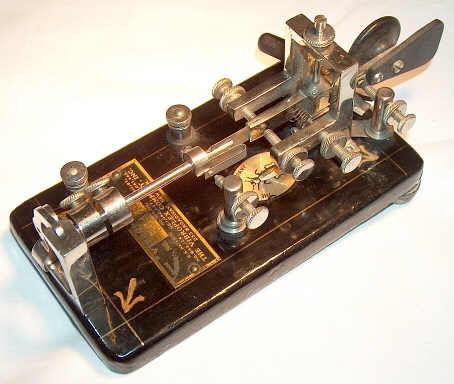
International Morse code today is most popular among amateur radio operators, where it is used as the pattern to key a transmitter on and off in the radio communications mode commonly referred to as "continuous wave" or "CW". The original amateur radio operators used Morse code exclusively, as voice-capable radio transmitters did not become commonly available until around 1920. Until 2003 the International Telecommunication Union (ITU) mandated Morse code proficiency as part of the amateur radio licensing procedure worldwide. However, the World Radiocommunication Conference of 2003 (WRC-03) made the Morse code requirement for amateur radio licensing optional.[2] Many countries subsequently removed the Morse requirement from their licence requirements.[3]
Until 1991, a demonstration of the ability to send and receive Morse code at 5 words per minute (WPM) was required to receive an amateur radio license for use in the United States from the Federal Communications Commission. Demonstration of this ability was still required for the privilege to use the HF bands. Until 2000, proficiency at the 20 WPM level was required to receive the highest level of amateur license (Extra Class); effective April 15, 2000, the FCC reduced the Extra Class requirement to 5 WPM.[4] Finally, effective February 23, 2007, the FCC eliminated the Morse code proficiency requirements for all amateur licenses.
While voice and data transmissions are limited to specific amateur radio bands under U.S. rules, CW is permitted on all amateur bands—LF, MF, HF, UHF, and VHF, with one notable exception being the 60 meter band in the US. In some countries, certain portions of the amateur radio bands are reserved for transmission of Morse code signals only. Because Morse transmissions employ an on-off keyed radio signal, it requires less complex transmission equipment than other forms of radio communication. Morse code also requires less signal bandwidth than voice communication, typically 100–150 Hz, compared to the roughly 2400 Hz used by single-sideband voice, although at a lower data rate. Morse code is received as a high-pitched audio tone, so transmissions are easier to copy than voice through the noise on congested frequencies, and it can be used in very high noise / low signal environments. The fact that the transmitted energy is concentrated into a very limited bandwidth makes it possible to use narrow receiver filters, which suppress or eliminate interference on nearby frequencies. The narrow signal bandwidth also takes advantage of the natural aural selectivity of the human brain, further enhancing weak signal readability. This efficiency makes CW extremely useful for DX (distance) transmissions, as well as for low-power transmissions (commonly called "QRP operators", from the Q-code for "reduce power"). There are several amateur clubs that require solid high speed copy, the highest of these has a standard of 60 WPM. The American Radio Relay League offers a code proficiency certification program that starts at 10 WPM.
The relatively limited speed at which Morse code can be sent led to the development of an extensive number of abbreviations to speed communication. These include prosigns and Q codes, plus a restricted standardized format for typical messages. This use of abbreviations also facilitates communication between operators who do not share a common language and thus would have great difficulty in communicating using voice modes.
Although the traditional telegraph key (straight key) is still used by many amateurs, the use of semi- and fully-automatic electronic keyers (known as "bugs") is prevalent today. Computer software is also frequently employed to produce and decode Morse code radio signals.
OTHER USES.
Operators skilled in Morse code can often understand ("copy") code in their heads at rates in excess of 40 WPM. International contests in code copying are still occasionally held. In July 1939 at a contest in Asheville in the United States Ted R. McElroy set a still-standing record for Morse copying, 75.2 WPM.[5] In his online book on high speed sending, William Pierpont N0HFF notes some operators may have passed 100 WPM. By this time they are "hearing" phrases and sentences rather than words. The fastest speed ever sent by a straight key was achieved in 1942 by Harry Turner W9YZE (d. 1992) who reached 35 WPM in a demonstration at a U.S. Army base.[6]
As of 2007 commercial radiotelegraph licenses are still being issued in the United States by the Federal Communications Commission. Designed for shipboard and coast station operators, they are awarded to applicants who pass written examinations on advanced radio theory and show 20 WPM code proficiency [this requirement is waived for "old" (20 WPM) Amateur Extra Class licensees]. However, since 1999 the use of satellite and very high frequency maritime communications systems (GMDSS) have essentially made them obsolete.
Radio navigation aids such as VORs and NDBs for aeronautical use broadcast identifying information in the form of Morse Code, though many VOR stations now also provide voice identification.
MORSE CODE
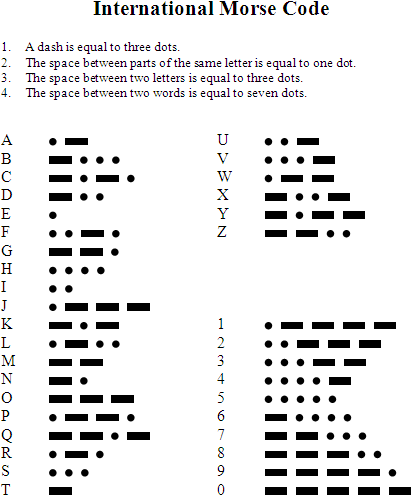
Morse code is a character encoding for transmitting telegraphic information, using standardized sequences of short and long elements to represent the letters, numerals, punctuation and special characters of a given message. The short and long elements can be formed by sounds, marks, or pulses, in on off keying and are commonly known as "dots" and "dashes" or "dits" and "dahs".
Originally created for Samuel Finley Breese Morse's electric telegraph in the early 1840s, Morse code was also extensively used for early radio communication beginning in the 1890s. For the first half of the twentieth century, the majority of high-speed international communication was conducted in Morse code, using telegraph lines, undersea cables, and radio circuits. However, the variable length of the Morse characters made it hard to adapt to automated circuits, so for most electronic communication it has been replaced by machine readable formats, such as Baudot code and ASCII.
The most popular current use of Morse code is by amateur radio operators, although it is no longer a requirement for amateur licensing in many countries. It also continues to be used for specialized purposes, including identification of navigational radio beacon and land mobile transmitters. Morse code is designed to be read by humans without a decoding device, making it useful for sending automated digital data in voice channels. For emergency signaling, Morse code can be sent by way of improvised sources that can be easily "keyed" on and off.
DEVELPOMENT AND HISTORY
Beginning in 1836, Samuel F. B. Morse and Alfred Vail developed an electric telegraph, which sent pulses of electrical current to control an electromagnet that was located at the receiving end of the telegraph wire. The technology available at the time made it impossible to print characters in a readable form, so the inventors had to devise an alternate means of communication. Beginning in 1837, William Cooke and Charles Wheatstone operated electric telegraphs in England, which also controlled electromagnets in the receivers; however, their systems used needle pointers that rotated to indicate the alphabetic characters being sent.
In contrast, Morse's and Vail's initial telegraph, which first went into operation in 1844, made indentations on a paper tape when an electrical current was transmitted. Morse's original telegraph receiver used a mechanical clockwork to move a paper tape. When an electrical current was received, an electromagnet engaged an armature that pushed a stylus onto the moving paper tape, making an indentation on the tape. When the current was interrupted, the electromagnet retracted the stylus, and that portion of the moving tape remained unmarked.
The Morse code was developed so that operators could translate the indentations marked on the paper tape into text messages. In his earliest code, Morse had planned to only transmit numerals, and use a dictionary to look up each word according to the number which had been sent. However, the code was soon expanded to include letters and special characters, so it could be used more generally. The shorter marks were called "dots", and the longer ones "dashes", and the letters most commonly used in the English language were assigned the shortest sequences.
In the original Morse telegraphs, the receiver's armature made a clicking noise as it moved into and out of position to mark the tape. Operators soon learned to translate the clicks directly into dots and dashes, making it unnecessary to use the paper tape. When Morse code was adapted to radio, the dots and dashes were sent as short and long pulses. It was later found that people become more proficient at receiving Morse code when it is taught as a language that is heard, instead of one read from a page.[1] To reflect the sound of Morse code, practitioners began to vocalise a dot as "dit", and a dash as "dah".
Morse code was an integral part of international aviation. Commercial and military pilots were required to be familiar with it, both for use with early communications systems and identification of navigational beacons which transmitted continuous three letter ID's in Morse code. As late as the 1990s, aeronautical charts listed the three letter ID of each airport in Morse and sectional charts still show the Morse signals for Vortac and NDB used for in flight navigation.
Morse code was also used as an international standard for maritime communication until 1999, when it was replaced by the Global Maritime Distress Safety System. When the French navy ceased using Morse code in 1997, the final message transmitted was "Calling all. This is our last cry before our eternal silence." See also: 500 kHz
Subscribe to:
Posts (Atom)