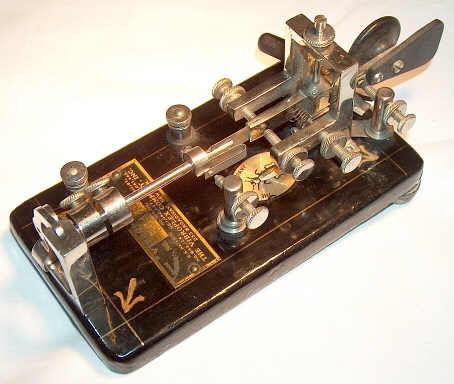
International Morse code today is most popular among amateur radio operators, where it is used as the pattern to key a transmitter on and off in the radio communications mode commonly referred to as "continuous wave" or "CW". The original amateur radio operators used Morse code exclusively, as voice-capable radio transmitters did not become commonly available until around 1920. Until 2003 the International Telecommunication Union (ITU) mandated Morse code proficiency as part of the amateur radio licensing procedure worldwide. However, the World Radiocommunication Conference of 2003 (WRC-03) made the Morse code requirement for amateur radio licensing optional.[2] Many countries subsequently removed the Morse requirement from their licence requirements.[3]
Until 1991, a demonstration of the ability to send and receive Morse code at 5 words per minute (WPM) was required to receive an amateur radio license for use in the United States from the Federal Communications Commission. Demonstration of this ability was still required for the privilege to use the HF bands. Until 2000, proficiency at the 20 WPM level was required to receive the highest level of amateur license (Extra Class); effective April 15, 2000, the FCC reduced the Extra Class requirement to 5 WPM.[4] Finally, effective February 23, 2007, the FCC eliminated the Morse code proficiency requirements for all amateur licenses.
While voice and data transmissions are limited to specific amateur radio bands under U.S. rules, CW is permitted on all amateur bands—LF, MF, HF, UHF, and VHF, with one notable exception being the 60 meter band in the US. In some countries, certain portions of the amateur radio bands are reserved for transmission of Morse code signals only. Because Morse transmissions employ an on-off keyed radio signal, it requires less complex transmission equipment than other forms of radio communication. Morse code also requires less signal bandwidth than voice communication, typically 100–150 Hz, compared to the roughly 2400 Hz used by single-sideband voice, although at a lower data rate. Morse code is received as a high-pitched audio tone, so transmissions are easier to copy than voice through the noise on congested frequencies, and it can be used in very high noise / low signal environments. The fact that the transmitted energy is concentrated into a very limited bandwidth makes it possible to use narrow receiver filters, which suppress or eliminate interference on nearby frequencies. The narrow signal bandwidth also takes advantage of the natural aural selectivity of the human brain, further enhancing weak signal readability. This efficiency makes CW extremely useful for DX (distance) transmissions, as well as for low-power transmissions (commonly called "QRP operators", from the Q-code for "reduce power"). There are several amateur clubs that require solid high speed copy, the highest of these has a standard of 60 WPM. The American Radio Relay League offers a code proficiency certification program that starts at 10 WPM.
The relatively limited speed at which Morse code can be sent led to the development of an extensive number of abbreviations to speed communication. These include prosigns and Q codes, plus a restricted standardized format for typical messages. This use of abbreviations also facilitates communication between operators who do not share a common language and thus would have great difficulty in communicating using voice modes.
Although the traditional telegraph key (straight key) is still used by many amateurs, the use of semi- and fully-automatic electronic keyers (known as "bugs") is prevalent today. Computer software is also frequently employed to produce and decode Morse code radio signals.
OTHER USES.
Operators skilled in Morse code can often understand ("copy") code in their heads at rates in excess of 40 WPM. International contests in code copying are still occasionally held. In July 1939 at a contest in Asheville in the United States Ted R. McElroy set a still-standing record for Morse copying, 75.2 WPM.[5] In his online book on high speed sending, William Pierpont N0HFF notes some operators may have passed 100 WPM. By this time they are "hearing" phrases and sentences rather than words. The fastest speed ever sent by a straight key was achieved in 1942 by Harry Turner W9YZE (d. 1992) who reached 35 WPM in a demonstration at a U.S. Army base.[6]
As of 2007 commercial radiotelegraph licenses are still being issued in the United States by the Federal Communications Commission. Designed for shipboard and coast station operators, they are awarded to applicants who pass written examinations on advanced radio theory and show 20 WPM code proficiency [this requirement is waived for "old" (20 WPM) Amateur Extra Class licensees]. However, since 1999 the use of satellite and very high frequency maritime communications systems (GMDSS) have essentially made them obsolete.
Radio navigation aids such as VORs and NDBs for aeronautical use broadcast identifying information in the form of Morse Code, though many VOR stations now also provide voice identification.

No comments:
Post a Comment